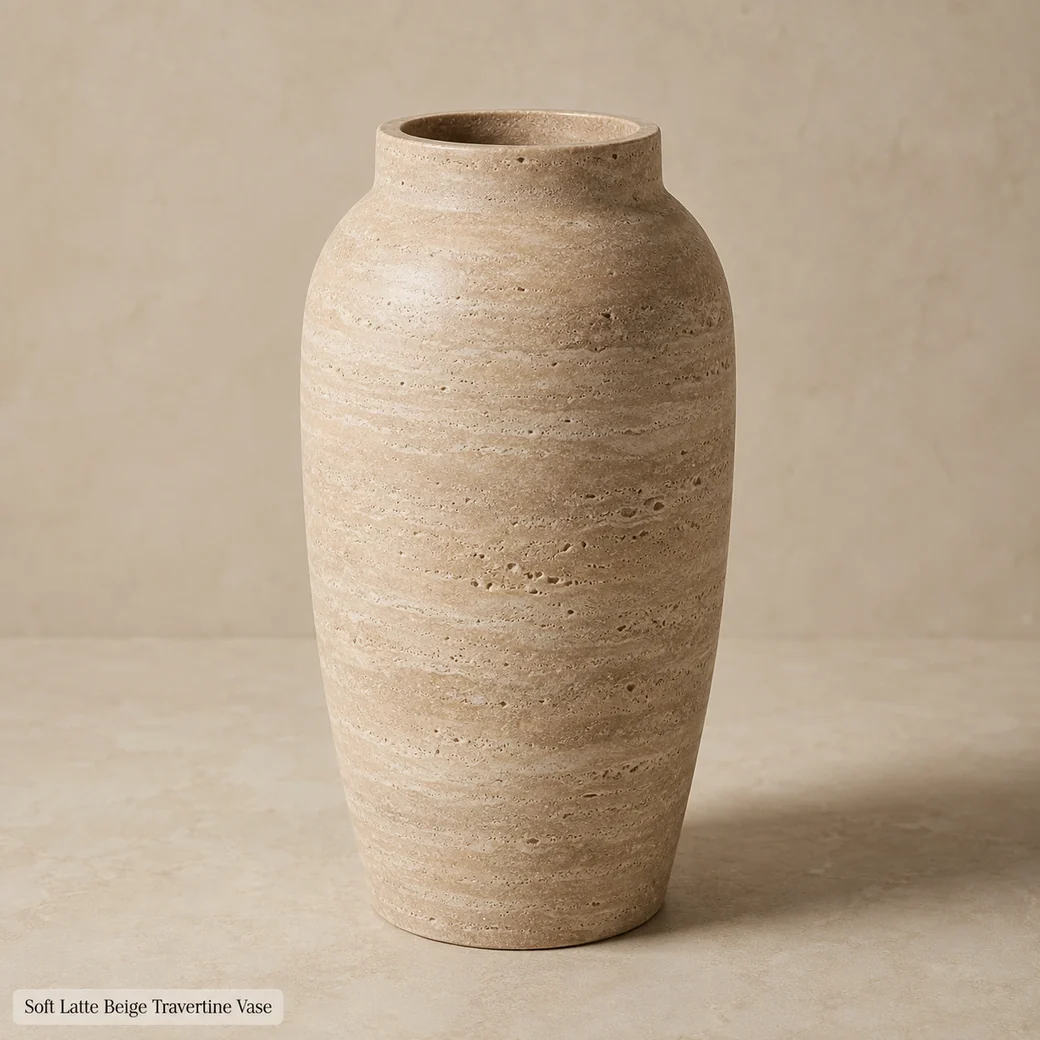
A travertine vase can hold dried arrangements directly, while fresh flowers are safest with a watertight insert unless the piece is specifically sealed and tested for water retention. Many decorative vases are carved from solid stone, so natural pores and cavities are expected visual characteristics. Branches, dried grasses and sculptural flowers suit the stone’s weight well. Clean with a soft cloth and avoid prolonged water staining or acidic cleaners.
Sculptural Stone Décor
Travertine Vase Small
Secure product inquiry
Buy now
Cash on delivery available. Product details are pre-filled below. Owner delivery adds AED 5,000.
Water Lining & Flower Use
A Natural Vessel Beyond Floral Display
This Ø16 × 28 cm honed travertine vase works naturally with dried grasses, branches and artificial arrangements. Fresh flowers should only be placed directly inside if the vessel has been properly sealed and confirmed watertight; otherwise a removable liner is preferable. Its 5 kg stone mass gives good stability for taller arrangements while the natural pores and veining keep each piece visibly individual.
Sculptural Stone Décor
Latte Beige Travertine Flower Vase
The Latte Beige Travertine Flower Vase is a Ø16 × 28 cm honed decorative vessel carved from beige natural travertine. Its soft latte tone allows it to work as a quiet sculptural object even without flowers, while the 5 kg stone body gives useful stability for taller dried grasses, branches and other architectural arrangements. The compact vertical format makes it appropriate for consoles, sideboards, dining tables and display shelving where natural stone is intended to contribute texture as well as function.
Arrangement Planning
How to Use a Travertine Decorative Vase
At Ø16 × 28 cm and 5 kg, the travertine vase is particularly well suited to dried grasses, branches and sculptural arrangements because its stone mass provides stability. Fresh flowers should only be placed directly inside if the vessel has been confirmed watertight; otherwise, use a removable watertight insert so standing water does not migrate into the natural pores or stain the exterior.
Add a Watertight Insert for Cut Flowers
Fresh flowers should use a watertight internal liner unless the travertine vase has been specifically sealed and tested to retain water without seepage or staining.
Style a Stone Vessel with Dried Botanicals
Branches, dried grasses and artificial flowers suit the Ø16 × 28 cm vase particularly well because they create height without introducing water into the porous stone.
Understand Pores in a Travertine Flower Vessel
Small holes, pores and tonal variation are natural characteristics of the travertine vase rather than automatic defects in the finished stone.
Product Data
Beige Travertine Vase Product Details
This small vase uses honed Beige Travertine in soft latte beige, measuring Ø16 × 28 cm and weighing 5 kg. Dried arrangements can sit directly in the stone, while fresh flowers should use a watertight insert unless the vase has specifically been sealed and tested to retain water.
| Mouth Opening Diameter | Approx. Ø8 cm mouth opening |
|---|---|
| Internal Cavity Depth | Approx. 23 cm usable internal cavity depth below the Ø8 cm mouth |
| Wall Thickness | Approx. 30–35 mm wall thickness around the internal vase cavity |
| Base Contact Diameter | Approx. Ø11 cm flat base-contact diameter for stable placement |
| Rim Profile | R3 mm eased outer and inner rim around the Ø8 cm mouth opening |
| Interior Surface Finish | Smooth-honed internal cavity with sealed, eased surfaces; use a watertight insert for fresh flowers |
| Center-of-Gravity Position | Centre of gravity maintained within the lower third of the vase height when empty |
| Arrangement Load Limit | Maximum 2 kg evenly distributed arrangement load, centred over the vase opening |
| Carving Method | CNC rough-carved from a solid travertine block, then hand-honed internally and externally to the final profile |
| Bottom Felt Pad | 2 mm self-adhesive beige felt pad covering the complete base-contact area |
Decorative Customization
Custom Travertine Stone Vase Options
Custom vases can be produced as taller floor pieces, simple cylinders, ring-handle vessels or asymmetrical sculptural forms. Diameter, mouth opening, cavity depth and overall height can be adjusted to the intended arrangement, with stone thickness and base proportions retained for stability.
Interior Styling
Why Choose a Natural Stone Decorative Vessel
A natural stone decorative vessel adds sculptural weight and authentic mineral variation to consoles, dining tables, shelves and entrance displays. Travertine works particularly well with dried grasses, branches and architectural floral arrangements because its substantial base supports taller compositions, while fresh flowers can be accommodated with a suitable watertight insert.
- Solid Stone Weight
The 5 kg solid-stone weight keeps taller dried branches and sculptural arrangements stable during display.
- Natural Pore Character
Natural pores and small cavities remain visible in the honed travertine, giving each vase authentic stone character.
- Dried Flower Ready
The solid travertine vase can hold dried flowers, branches and grasses directly without requiring a watertight insert.
- Custom Sculptural Forms
Travertine can be carved into cylindrical, tapered, fluted or other sculptural vase forms for different decorative arrangements.
Water & Surface Care
Maintaining a Travertine Flower Container
Use a watertight liner for fresh flowers unless the travertine vase has been specifically sealed and tested to hold water, and do not allow standing moisture to remain against the honed interior or exterior. Wipe the 5 kg piece with a soft cloth and non-acidic cleaner, treating its porous beige stone with the same material awareness applied to other decorative stones such as omani beige marble.

Technical Specification
Travertine Vase Specifications
Use the vase specifications to confirm whether the vessel itself is watertight or should be used with a separate liner before adding fresh flowers. The intended-arrangement field also helps distinguish suitable use for fresh stems, dried botanicals or decorative branches.
Product details
Specifications, care, delivery and FAQ
Everything is rendered from product JSON fields so the page remains SEO-ready even before JavaScript runs.
Cleaning: Empty water and remove the insert before cleaning, wipe honed travertine with pH-neutral stone cleaner and microfiber, treat persistent water rings with a stone-safe poultice, rinse minimally and dry fully, avoid vinegar lemon bleach abrasives and soaking porous stone
Daily Care: Use a watertight insert for fresh flowers, wipe condensation and water rings immediately, dust honed travertine with microfiber, clean with pH-neutral stone cleaner, dry the base before replacement, avoid acids abrasives and prolonged water contact
- Avoid filling directly with water unless watertight
- avoid acidic flower preservatives
- avoid prolonged condensation beneath the vase
- avoid abrasive cleaning
- avoid lifting the 5 kg vase by a vulnerable rim
Maintenance: Use a watertight insert for fresh flowers, wipe condensation immediately, clean honed travertine with pH-neutral stone cleaner, dry the base before replacement, inspect for hairline cracks, use a non-staining pad beneath the vase
Handling: Empty water and remove flowers or insert, lift the 5 kg vase with one hand beneath the base and one around the body, keep it upright, protect the rim, use a padded tray, never carry it by the neck alone
Can this honed travertine vase safely hold water for fresh flowers directly, or should I use a watertight internal insert to prevent seepage and dark moisture marks?
Use a watertight glass, acrylic or stainless-steel insert inside the honed Travertine vase. Natural pores, filler joints or unseen fissures can allow slow seepage, while prolonged internal moisture may create dark patches, salt deposits or staining. The insert should fit without concentrating pressure against the stone walls and should be removable for cleaning. If direct water use is intended, obtain written confirmation that the vase has a suitable internal waterproof system and test it on a protected surface before placing it on furniture.
Which watertight liner material and size work best inside this travertine vase when it is used for fresh flowers?
A removable borosilicate glass liner is the best option because it is watertight, chemically stable, easy to clean and visually discreet. Clear acrylic is lighter but scratches more easily, while stainless steel may alter the appearance and can concentrate pressure at its rim. Select an insert roughly 1–2 cm smaller than the vase’s internal diameter and slightly shorter than its cavity, with soft clear pads preventing hard contact. Lift the liner out for refilling rather than pouring water directly into the honed Travertine vase.
Will sealing the internal cavity of this travertine vase darken the stone, increase gloss or alter its natural pore appearance?
An impregnating sealer may deepen the colour slightly, but it should not create significant gloss when correctly applied and excess material is removed. Film-forming coatings can visibly darken pores and add sheen; test the exact product inside an inconspicuous area and use a waterproof removable insert if the vase will hold water.
How can a water ring beneath the honed Travertine Vase be removed without using acidic cleaners, spreading the stain or changing the surrounding stone finish?
First allow the vase and surface to dry completely because a temporary moisture ring may disappear naturally. Clean remaining mineral residue with pH-neutral stone cleaner and a soft cloth; if discoloration persists, use a professionally selected non-acidic poultice confined to the mark and feathered outward. Avoid vinegar, descaler and aggressive rubbing, then use a waterproof insert and non-staining coaster to prevent recurrence.
Which flower stems, branches and dried arrangements work best with this vase’s narrow opening without overcrowding it or making the 28 cm-high stone vessel unstable?
Tall dried grasses, slender branches and a limited number of long-stem flowers suit the narrow opening best because they preserve vertical proportion without creating a top-heavy arrangement. Keep heavy foliage modest, distribute stems evenly and use a removable insert or internal support grid; very dense bouquets can shift the 5 kg vase’s centre of gravity beyond its 16 cm base.
Reviews
Reviews and new review submission
0.0 average rating from 0 reviews. New reviews are saved as pending until approved.
No approved reviews yet for this product. The review form is ready for buyer submissions.