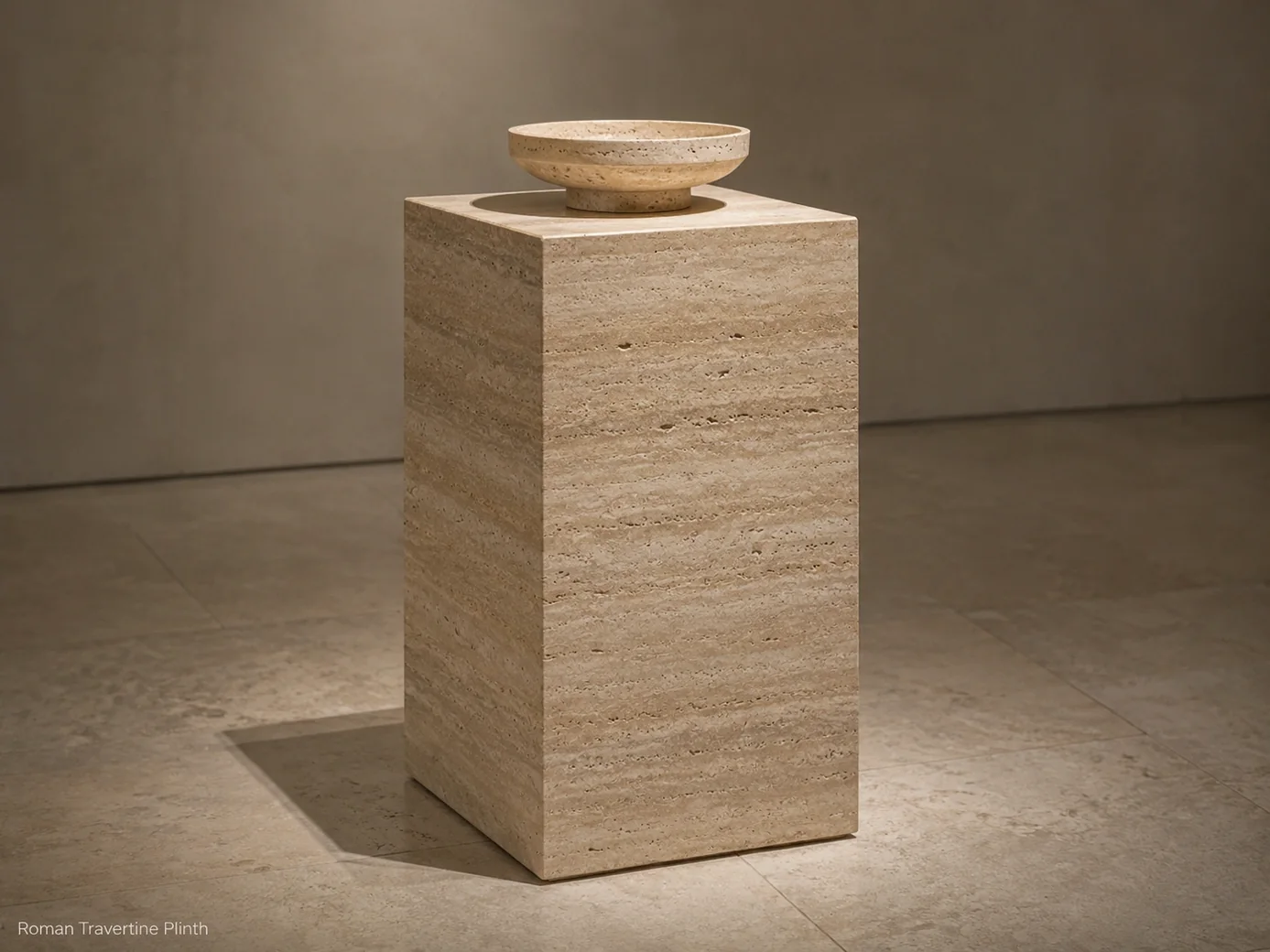
A travertine plinth is designed to elevate sculpture, art, retail displays or decorative objects, and its ideal height depends on the object and viewing level rather than one fixed standard. It may be carved from solid stone or fabricated as a lighter clad structure, so load capacity must be confirmed from its construction. Dimensions can be made to order, while cleaning should use a soft cloth and pH-neutral stone product.
Architectural Display & Sculpture Base
Travertine Plinth Small
Secure product inquiry
Buy now
Cash on delivery available. Product details are pre-filled below. Owner delivery adds AED 5,000.
Height, Load & Display Use
Elevating Art, Objects and Interiors
Travertine plinths can serve as display pedestals, sculpture stands or occasional tables, with common 30 × 30 cm footprints offered in heights from around 50 cm to well over one metre. Taller examples around 105–125 cm suit art or retail display, while lower formats work beside seating. This solid 30 × 30 × 60 cm piece weighs 38 kg, so it offers substantial stability but should be positioned with floor loading and moving access in mind.
Sculptural Display Furniture
Tivoli Travertine Display Pedestal
The Tivoli Travertine Display Pedestal is a 30 × 30 × 60 cm sanded stone column designed to raise displayed objects to a more deliberate viewing height. Its warm beige surface and natural linear bands provide a neutral architectural base for sculpture, lamps, plants and retail merchandise without competing heavily with the item being presented. At 38 kg, it has the stability required for a dedicated display element and can also function as an occasional side table where a compact vertical stone form suits the interior.
Display Planning
How to Size a Travertine Sculpture Stand
The 30 × 30 × 60 cm travertine plinth should be sized around both the displayed object and the intended viewing level. Its 30 cm square top needs to support the object’s footprint without unstable overhang, while the 60 cm height should raise sculpture or art to a useful sightline; taller objects generally need a lower plinth, whereas smaller pieces can benefit from greater elevation.
Choose Solid Stone or Clad Display Columns
Solid travertine gives maximum mass and a monolithic 38 kg presence, while veneer over an engineered frame reduces weight and simplifies installation without becoming structural stone.
Match a Stone Pedestal to Display Weight
The displayed object should remain within the 30 × 30 cm support footprint, with allowable load confirmed from whether the plinth is solid or clad construction.
Create Multi-Level Travertine Display Plinths
Grouping 60, 85 and 100 cm plinth heights creates a stepped display composition for objects that need different viewing levels.
Product Data
Tivoli Travertine Pedestal Product Details
This small pedestal uses sanded Tivoli Travertine in warm beige with natural linear bands. Its 30 × 30 × 60 cm format weighs 38 kg, producing a compact but substantial display plinth for sculpture, retail objects or decorative pieces whose load suits the actual construction.
| Top Flatness Tolerance | Target top flatness: ≤0.6 mm deviation across 300 mm |
|---|---|
| Hidden Internal Frame Material | 25 × 25 × 2 mm powder-coated steel SHS internal frame |
| Base Levelling Feet | Four concealed M8 × 25 mm threaded levelling feet with non-marking nylon pads and ±10 mm adjustment |
| Security Fixing Point | Concealed M10 stainless-steel threaded insert centred in the underside for anti-tip anchoring to the substrate |
| Display Pad Material | 3 mm neutral-coloured closed-cell silicone display pad protecting the stone top and displayed object |
| Floor Protection Pad | 5 mm non-marking EPDM rubber pad covering the complete floor-contact footprint |
| Lifting Recess Provision | Two concealed 100 × 30 × 25 mm lifting recesses on opposing underside edges |
| Top Centering Mark | Fine 20 mm engraved crosshair marking the exact centre of the top display surface |
| Hollow-Core Wall Thickness | Approx. 25 mm stone wall thickness around the hollow reinforced plinth core |
| Crating Footprint | Approx. 400 × 400 × 700 mm protective crate footprint including 50 mm cushioning clearance |
Bespoke Display Design
Custom Travertine Plinth Options
Travertine plinths can be produced as smooth or fluted columns in square, rectangular or project-specific proportions. Custom height allows the displayed sculpture or product to sit at the correct viewing level, while polished, honed, brushed or sanded finishes can be matched to the object and surrounding interior.
Display Versatility
Why Choose a Natural Stone Sculpture Pedestal
A natural stone sculpture pedestal gives artwork, retail objects and decorative pieces a defined viewing height while adding enough visual and physical weight to ground the display. Travertine plinths can be proportioned to the object and fabricated as solid or clad structures, making them suitable for galleries, entrances, boutiques and residential interiors.
- Art Display Support
The travertine plinth provides a stable elevated platform that positions sculpture and art closer to the intended viewing level.
- Retail Product Elevation
The 60 cm-high plinth raises retail products or decorative objects closer to the intended viewing level.
- Plant Pedestal Use
The 60 cm-high plinth can elevate indoor plants and planters to create a more deliberate decorative display.
- Custom Height Options
Plinth height can be customized to position sculpture, plants or retail objects at the intended viewing level.
Placement & Care
Maintaining a Tivoli Travertine Display Column
Place the 38 kg Tivoli travertine plinth on a level surface with suitable floor protection beneath it, and never load it with an oversized or unstable object that exceeds the pedestal's engineered capacity. Clean using a soft cloth and pH-neutral stone product while avoiding acids, a care approach that established marble suppliers in dubai also emphasize for calcium-based natural stones.

Technical Specification
Travertine Pedestal Specifications
Check the pedestal specifications for construction type and intended load before placing sculpture, art or retail objects on the plinth. The customization fields are especially useful when you need the height, footprint or construction adapted to the weight and viewing position of a particular display piece.
Product details
Specifications, care, delivery and FAQ
Everything is rendered from product JSON fields so the page remains SEO-ready even before JavaScript runs.
Cleaning: Dust the sanded surface using microfiber or a soft brush, lift displayed objects before cleaning, wipe with a lightly damp pH-neutral stone-cleaner cloth, dry the top and lower edges, remove scuffs without abrasive rubbing, avoid acids bleach and furniture wax
Daily Care: Dust the sanded surface daily, lift displayed objects instead of dragging them, use non-staining pads beneath exhibits, wipe marks with a barely damp pH-neutral cleaner cloth, keep loads centered, avoid acids abrasives and wet décor
- Avoid edge-loading the 30 × 30 cm top
- avoid exceeding the verified structural capacity
- avoid dragging sculptures across travertine
- avoid acidic cleaners
- avoid placing the plinth on an uneven floor
Maintenance: Remove the display object before cleaning, dust the sanded surface with a soft brush, wipe using pH-neutral stone cleaner, keep loads centered, inspect seams and internal support, renew non-staining top and floor pads when worn
Handling: Remove the sculpture or display item first, use two people for the 38 kg plinth, lift from the base with even support, keep it upright, pad sanded corners, center the load only after the plinth is level
How much smaller should the sculpture's base be than the 30 × 30 cm top of this travertine plinth to keep the display visually balanced and structurally stable?
For a 30 × 30 cm plinth top, keep the sculpture base within approximately 20–24 cm square or diameter, leaving 3–5 cm of visible stone around every side. This creates visual breathing space and keeps the load closer to the centre, improving stability. The sculpture’s centre of gravity, weight and height matter more than footprint alone; a tall or asymmetrical piece may need a smaller base, concealed pin or internal reinforcement. Obtain the plinth’s verified load rating before placing a valuable sculpture on it.
Does this 60 cm travertine plinth require concealed floor or wall anchoring when displaying tall artwork with a high centre of gravity?
Hidden anchoring is recommended when tall artwork creates a high centre of gravity, particularly in public, commercial or child-accessible areas. The anchor should connect the artwork, plinth structure and suitable floor or wall substrate without point-loading the travertine; a stability assessment must consider accidental impact and seismic or local code requirements.
Which continuous pad or concealed floor protectors will prevent this 38 kg travertine plinth from scratching or staining finished flooring?
Use a continuous sheet of dense, colourfast felt or non-staining isolation material to distribute the 38 kg load and stop grit contacting the floor. Alternatively, install several broad silicone or elastomer pads directly beneath supported structural zones; avoid small soft feet that create concentrated pressure or adhesives that may discolor stone or flooring.
How should a sculpture’s weight be distributed across the 30 × 30 cm top of the Travertine Plinth to avoid edge loading, instability or localized stone damage?
Centre the sculpture’s bearing area over the plinth and use a rigid load-spreading plate or non-staining isolation pad where the object has small feet or irregular contact points. Keep concentrated loads well away from the 30 × 30 cm edges, confirm that the entire centre of gravity remains within the base and mechanically restrain tall or asymmetric artwork rather than relying on the 38 kg plinth alone.
Is a solid or engineered hollow-core travertine plinth more practical when the 60 cm display pedestal must be relocated frequently without sacrificing stability or load capacity?
An engineered hollow-core plinth is more practical for frequent relocation because it reduces weight while retaining a rigid framed structure and stable base. Solid travertine offers maximum mass but is difficult and hazardous to move; the hollow version still needs a verified top-load rating, reinforced corners, concealed lifting access and sufficient ballast or anchoring for tall displays.
Reviews
Reviews and new review submission
0.0 average rating from 0 reviews. New reviews are saved as pending until approved.
No approved reviews yet for this product. The review form is ready for buyer submissions.