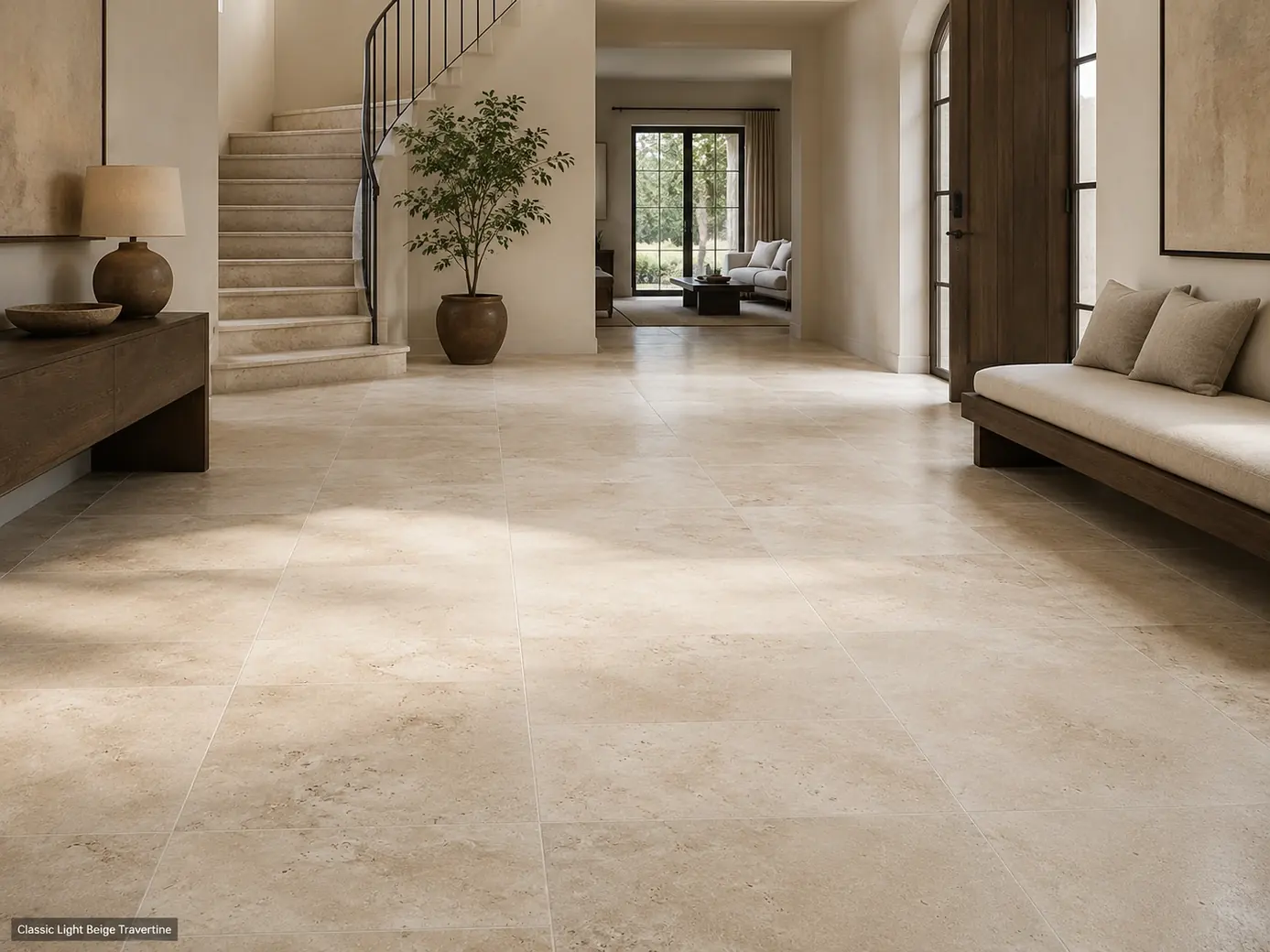
Travertine flooring is durable for residential and many commercial interiors when the correct grade and installation system are used. Its pores can benefit from an impregnating treatment where stain exposure is high, while polished stone may become slippery when wet. Honed, brushed or tumbled surfaces are generally more suitable for traffic and moisture. Exterior use is possible with the right thickness and texture; routine care should use pH-neutral cleaner rather than acidic products.
Durable Natural Stone Flooring
Travertine Flooring Small
Secure product inquiry
Buy now
Cash on delivery available. Product details are pre-filled below. Owner delivery adds AED 5,000.
Finish, Grip & Resealing
Creating Seamless Indoor-Outdoor Continuity
Travertine can connect interior floors with patios or poolside spaces through a consistent stone palette, but finish selection should change with the exposure. Honed surfaces suit many interiors, while wet exterior areas generally benefit from more textured options because polished stone can become slippery. The material is porous and should be sealed as appropriate, installed over a sound substrate and cleaned with pH-neutral products, with periodic resealing expected over its service life.
Natural Stone Underfoot
Classic Light Travertine Floor Tiles
The Classic Light Travertine Floor Tile is a 60 × 60 × 1.8 cm honed natural-limestone surface with a soft creamy-sand appearance suited to larger continuous floor layouts. The generous square format reduces visual fragmentation compared with smaller tiles, making it particularly effective across residential interiors and hospitality spaces. With specification appropriate to the location, the same travertine character can also extend into selected exterior applications, allowing adjoining areas to maintain a coordinated natural-stone palette.
Floor System Planning
How to Specify a Travertine Floor
Specify the 60 × 60 × 1.8 cm travertine floor only after confirming that the substrate is flat, stable and capable of supporting the 16.2 kg tiles without movement. Honed surfaces are suitable for many interior traffic areas, but moisture exposure and expected foot traffic should determine whether additional texture is preferable; wet zones demand more attention to traction and waterproofing than dry living spaces.
Choose Travertine Flooring for Wet Areas
The honed surface offers more useful wet-condition texture than polished travertine, while brushed or more strongly textured finishes can provide additional traction where needed.
Protect Porous Natural Stone Flooring
Impregnation should respond to actual absorption and stain exposure, with periodic resealing based on performance rather than a fixed calendar alone.
Continue Travertine Tiles onto Patios
Exterior continuation requires stone thickness, surface texture, substrate and installation designed for outdoor exposure rather than simply repeating the 18 mm indoor tile.
Product Data
Classic Travertine Flooring Product Details
This flooring uses honed Classic Light Beige Travertine in soft creamy sand. Each 60 × 60 × 1.8 cm tile weighs 16.2 kg, giving an 18 mm natural-stone floor format intended for residential or suitable commercial installation when the substrate and fixing system are correctly prepared.
| Calibrated Thickness Tolerance | ±0.5 mm calibrated thickness tolerance |
|---|---|
| Tile Flatness Tolerance | Calibrated honed-tile flatness tolerance: 0.10%, equivalent to about 0.6 mm across 600 mm |
| Joint Width | 3 mm nominal grout-joint width for calibrated 600 × 600 mm honed floor tiles |
| Adhesive Bed Depth | Approx. 6–10 mm finished adhesive-bed depth using a full-coverage white natural-stone adhesive |
| Grout Type Compatibility | Compatible with flexible, non-staining grout formulated for natural stone; use an unsanded fine-joint product where polished edges could scratch |
| Movement Joint Spacing | Provide movement joints at maximum 4.5 m intervals internally, at room perimeters, structural joints, thresholds and changes of substrate |
| Underfloor Heating Compatibility | Compatible with low-temperature hydronic or electric underfloor heating when installed with flexible natural-stone adhesive, movement joints and gradual commissioning |
| Substrate Flatness Requirement | Maximum 3 mm substrate deviation beneath a 2 m straightedge before installation |
| Shade Blending Grade | V3 substantial natural shade variation; dry-lay and blend material from multiple crates across the complete room |
| Edge Chipping Tolerance | Minor edge chips not exceeding 2 mm may be accepted outside prominent sightlines; larger chips or damage at adjoining visible edges require replacement |
Project Layout
Custom Travertine Floor Design Options
Custom floor schemes can use square, rectangular, modular, French-pattern or border-cut tile formats in selected ivory, beige, walnut, silver or mixed tonal ranges. Grout-joint width should reflect calibration and installation type, while project quantities must include cutting waste, shade blending, spare tiles and material from coordinated production lots.
Surface Applications
Where Natural Travertine Flooring Works
Natural travertine flooring works particularly well in villa entrances, living areas, corridors, reception spaces and other residential or commercial interiors where a durable stone surface and warm neutral appearance are desired. With suitable textured finishes and installation detailing, it can also extend into selected moisture-prone or exterior areas.
- Villa Interior Floors
Honed light travertine provides a durable natural-stone floor for villa entrances, living areas and connecting corridors.
- Hospitality Floor Areas
Honed travertine can provide durable natural-stone flooring for hotel lobbies, corridors and other suitable hospitality interiors.
- Bathroom Honed Surfaces
Honed travertine provides a low-sheen bathroom floor surface that is more suitable for wet-area use than highly polished stone.
- Exterior Textured Zones
Brushed, tumbled or other textured travertine finishes can be specified for exterior zones requiring greater surface grip.
Installation & Maintenance
Caring for a Honed Travertine Floor
Install honed travertine over a sound, level substrate using professional cutting around walls, thresholds and services, and choose grout joints appropriate to the tile dimensions and movement conditions. Maintain the floor with pH-neutral cleaner and reassess impregnation or resealing according to traffic and absorption rather than a fixed schedule; dimensional planning is equally important when consulting a granite size reference for other stone installations.

Technical Specification
Travertine Floor Tile Specifications
Check the floor-tile specifications for slip intent, sealing requirements and installation method before selecting the material for a particular room or traffic condition. These fields help your installer match the tile treatment and fixing system to the actual substrate, moisture exposure and expected use.
Product details
Specifications, care, delivery and FAQ
Everything is rendered from product JSON fields so the page remains SEO-ready even before JavaScript runs.
Cleaning: Vacuum grit frequently with a soft-floor head, damp-mop using diluted pH-neutral stone cleaner, use clean water and a well-wrung mop, rinse residue and dry promptly, repair reopened holes before dirt embeds, avoid vinegar bleach abrasive pads and wax buildup
Daily Care: Vacuum grit with a soft-floor attachment, wipe spills immediately, damp-mop with diluted pH-neutral stone cleaner, dry wet areas, use clean entrance mats and furniture pads, inspect reopened pores, avoid acids abrasive pads and wax buildup
- Avoid acidic cleaning products
- avoid abrasive grit remaining on the floor
- avoid letting spills penetrate reopened pores
- avoid dragging unpadded furniture
- avoid applying wax or sealer over dirty or damp stone
Maintenance: Vacuum abrasive grit frequently, damp-mop with pH-neutral stone cleaner, wipe spills promptly, repair reopened holes and damaged joints, maintain entrance mats and furniture pads, reassess sealing when absorption increases
Handling: Lift replacement pieces with suction tools where suitable, carry tiles vertically with both hands, protect finished edges, keep grit away from stacked faces, use kneeling boards during installation, never drag equipment directly across the honed floor
Can this honed travertine flooring be installed safely over underfloor heating without causing cracking, adhesive problems or excessive temperature stress in the stone?
Honed travertine can be installed over underfloor heating when the substrate, heating system, adhesive and joints are designed as one assembly. Use a stable screed, flexible natural-stone adhesive, movement joints at required locations and gradual commissioning rather than sudden temperature changes. The 60 × 60 cm tiles must achieve full adhesive coverage with no voids. Allow the installation to cure completely before heating, then increase temperature slowly according to the system supplier’s instructions. The installer should verify moisture levels, maximum surface temperature and compatibility of every product.
Which warm grout colour will blend most naturally with the flooring’s cream and sand variation without creating a strongly visible grid between tiles?
A warm ivory, light beige or sand-coloured grout close to the tiles’ average midtone will blend the cream variation better than bright white or cool grey. Approve the colour using cured test joints across several light and dark tiles, since grout cards do not accurately show its finished appearance beside natural travertine.
Is a steam mop safe for sealed honed travertine flooring, or can heat and moisture damage the sealer, filler or stone joints?
A steam mop is not recommended for sealed honed travertine because sustained heat and moisture can weaken some sealers, affect fillers and drive water into joints. Clean with a well-wrung microfiber mop and pH-neutral stone cleaner, then dry the floor rather than allowing water or steam to remain on the surface.
How can pores or filled holes that reopen in Travertine Flooring after years of traffic be repaired so the new filler remains secure and visually matches the surrounding honed stone?
Remove all loose filler back to sound edges, vacuum the cavity and clean and dry it thoroughly before applying a colour-matched stone repair mortar, epoxy or resin selected for the hole size and traffic. Slightly overfill, allow full cure, then grind and hone flush with the surrounding floor; widespread reopening may indicate movement, voids or unsuitable original filler requiring professional assessment.
Will applying a penetrating sealer noticeably darken this light honed travertine floor, and should the exact product be tested on spare tiles before full application?
A true penetrating impregnator may deepen pale travertine slightly but should not create gloss or a surface film when correctly applied and wiped. Colour-enhancing products darken it intentionally, so test the exact standard sealer on spare tiles or an inconspicuous installed area, allow full curing and inspect under daylight before approving complete-floor treatment.
Reviews
Reviews and new review submission
0.0 average rating from 0 reviews. New reviews are saved as pending until approved.
No approved reviews yet for this product. The review form is ready for buyer submissions.