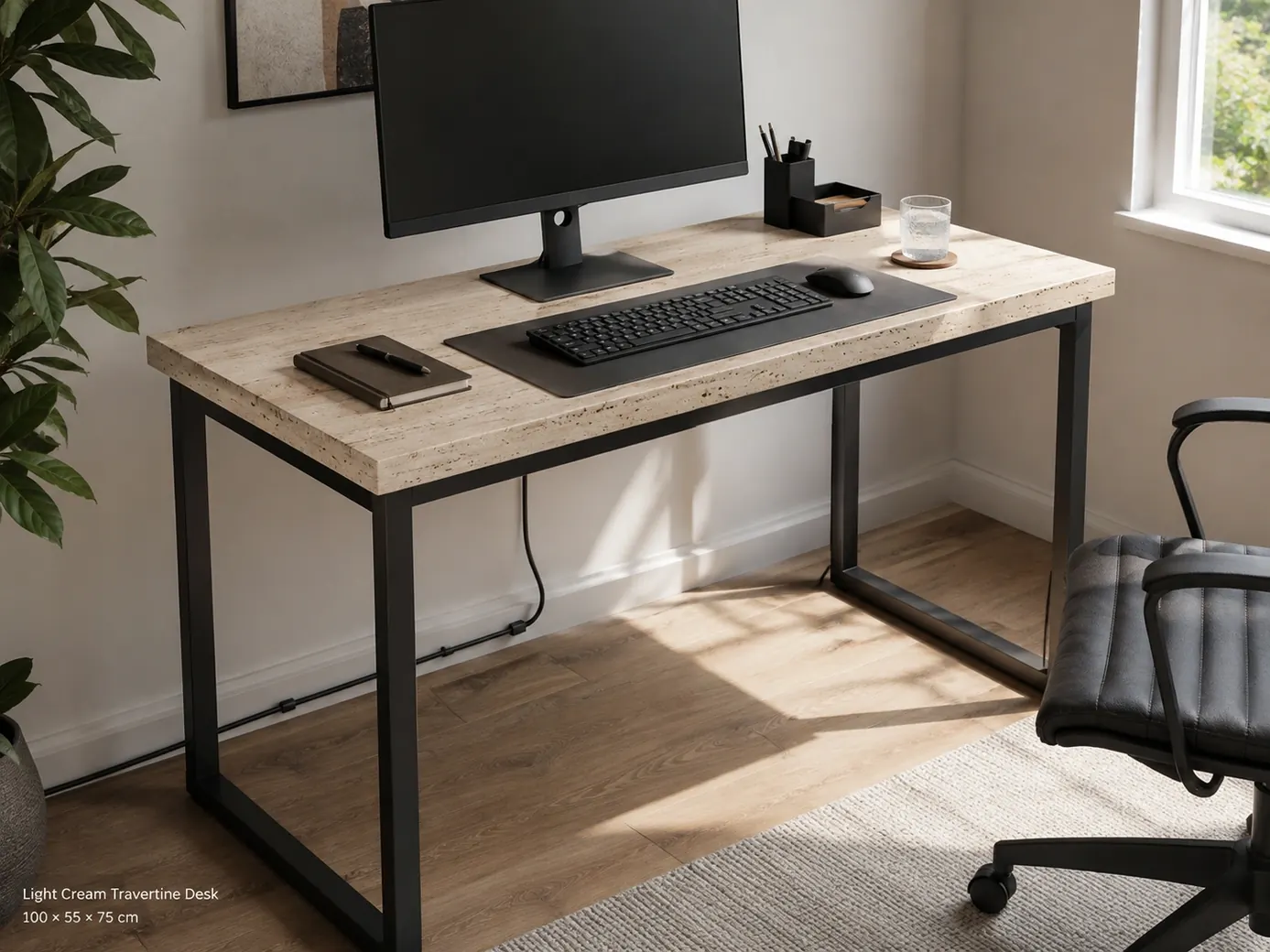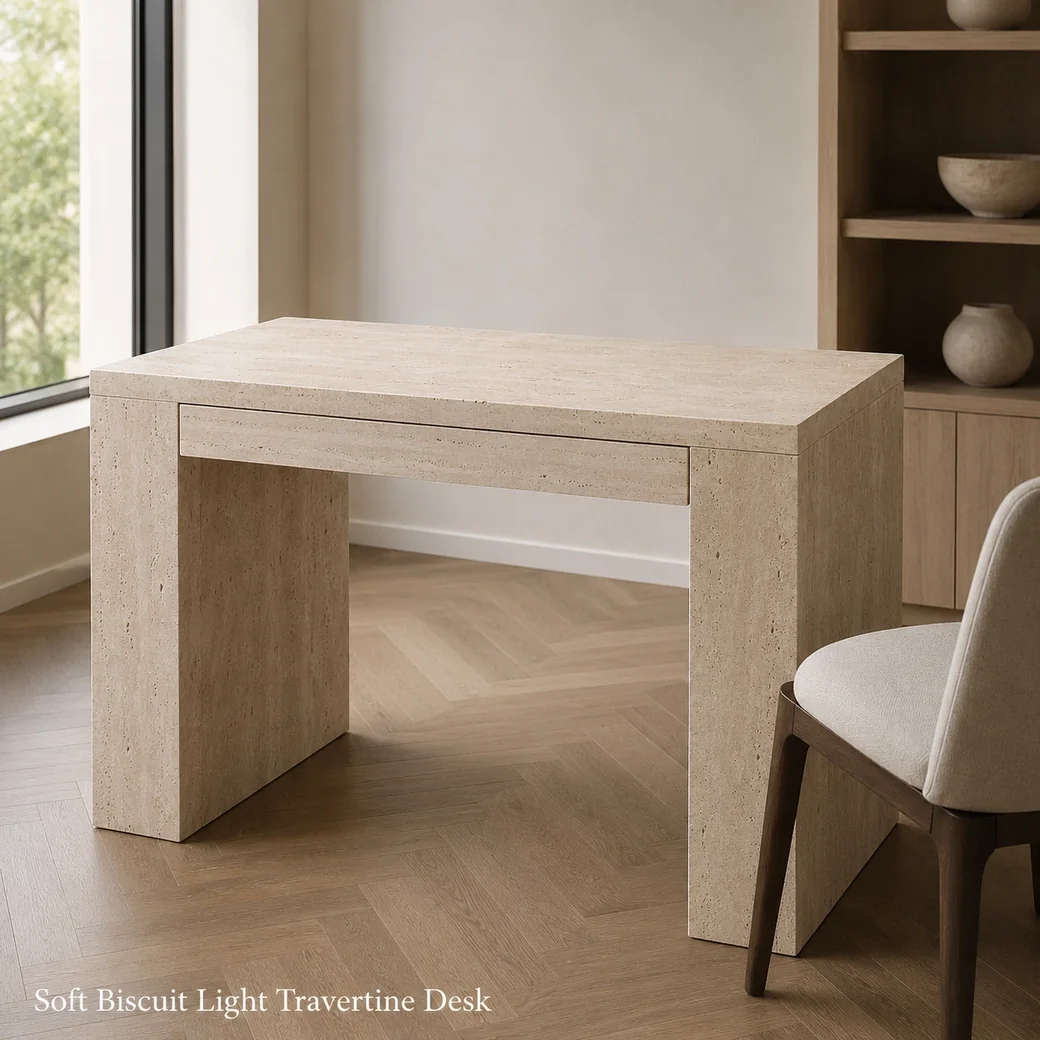
A travertine office desk is practical when the support frame is designed for its substantial weight. Standard desk height is generally around 71–76 cm, while width and depth should be selected around monitors, seating and storage needs. Drawers, cable openings and bespoke dimensions can be integrated during fabrication. Use coasters or desk mats under drinks, wipe spills quickly and clean the desktop with a non-acidic stone cleaner.
Natural Stone Workspace
Travertine Desk Small
Secure product inquiry
Buy now
Cash on delivery available. Product details are pre-filled below. Owner delivery adds AED 5,000.
Custom Sizing & Delivery Access
Crafted for Focused Everyday Work
At 100 × 55 × 75 cm, this honed light-cream travertine desk fits compact home offices and writing areas, while larger bespoke versions can extend to roughly 140–200 cm wide. Fluted legs, slab supports, tapered pedestals, drawers and mixed wood or metal details can be incorporated during fabrication. Its 45.5 kg weight should be considered when planning stairs, lifts and final-room access.
Natural Stone Workspace
Light Travertine Writing Desk
The Light Travertine Writing Desk is a 100 × 55 × 75 cm natural-stone workstation designed for home offices, private studies and creative studios where a compact desk still needs material presence. Its honed light-cream travertine has a soft biscuit-beige appearance that provides a calmer working surface than strongly patterned stone. At 45.5 kg, it feels considerably more permanent than conventional lightweight desks, making it particularly suitable for dedicated writing, laptop work and creative tasks in a fixed workspace.
Workspace Design
How to Configure a Travertine Office Table
The 100 × 55 × 75 cm travertine desk should be organized around the actual workstation: 100 cm width is best used for a compact monitor setup, while the 55 cm depth needs careful placement to preserve viewing distance and working space in front of the screen. Chair width, armrests and leg movement should remain clear beneath the desk, with cables or storage kept outside the knee zone rather than consuming the limited usable depth.
Add Storage to a Stone Writing Desk
Drawers should remain shallow or offset toward the sides so storage is added without reducing the central knee and chair clearance beneath the 75 cm-high desk.
Plan Power Access in a Travertine Workstation
Drill grommets and plan rear cable channels before fabrication so monitor and power leads pass through the stone without improvised cutting after installation.
Choose Slab, Fluted or Pedestal Desk Legs
Full-stone supports create a monolithic desk, while steel, timber or other engineered bases reduce visual mass and can simplify cable or storage integration.
Product Data
Light Travertine Desk Product Details
This small desk uses honed Light Cream Travertine in a soft biscuit-beige tone. Measuring 100 × 55 × 75 cm and weighing 45.5 kg, it creates a compact office-height work surface whose frame or stone supports must be designed to carry the finished load.
| Knee Clearance Width | 60 cm clear knee width |
|---|---|
| Knee Clearance Height | Approx. 67 cm clear floor-to-underside knee clearance height |
| Drawer Runner Type | 350 mm full-extension concealed undermount runners with integrated soft-close, tool-free drawer removal and minimum 40 kg dynamic load rating |
| Cable Grommet Diameter | Ø60 mm cable grommet positioned in the rear corner of the desktop |
| Monitor Arm Clamp Zone | Minimum 100 × 100 mm reinforced clamp zone along the rear edge, free from drawers and cable hardware |
| Power Module Cutout | Approx. 225 × 110 mm rectangular cutout with R5 mm corners for a recessed power module; final size to the selected unit’s template |
| Modesty Panel Height | Approx. 300 mm-high modesty panel positioned beneath the rear edge while preserving full knee clearance |
| Base Levelling Feet | Four concealed M8 stainless-steel levelling feet with non-marking nylon pads and approximately 10 mm adjustment |
| Frame Section Size | Minimum 40 × 40 × 2 mm welded steel frame section beneath the stone desktop |
| Edge Radius | R5 mm eased radius around the desktop perimeter and exposed corners |
Made-to-Order Workspace
Custom Travertine Executive Desk Options
An executive version can extend the desktop width and depth for multiple monitors, meetings or integrated storage, with soft-close drawers and planned cable access. Timber, brass or powder-coated metal accents can be incorporated into the support frame, and the actual travertine slabs can be selected for vein direction, colour continuity and suitable fabrication quality.
Professional Function
Why Choose a Travertine Home Office Desk
A travertine home office desk provides a substantial work surface for monitors, laptops and paperwork while allowing practical features such as cable openings, drawers and storage to be incorporated during fabrication. Bespoke sizing lets the desk respond to the room and equipment setup, making it more useful than a purely decorative stone table.
- Honed Work Surface
The honed travertine top provides a low-sheen work surface suitable for monitors, writing and everyday office use.
- Custom Drawer Options
Custom drawers can be integrated into the desk design for stationery, documents and everyday office storage.
- Planned Cable Openings
Cable openings can be positioned during fabrication to route monitor, charging and power leads through the stone work surface.
- Stable Stone Construction
The 45.5 kg stone construction gives the desk a firmly planted work surface when supported by a properly engineered base.
Delivery & Care
Protecting a Natural Stone Writing Table
Protect the honed writing surface with a desk mat beneath frequently moved equipment and coasters beneath drinks, avoiding acidic liquids and sharp objects that could stain, etch or scratch the stone. Because the desk weighs 45.5 kg, confirm delivery access, turning clearances and assembly sequence before arrival, using the same installation discipline required for services such as tile fixing dubai.

Technical Specification
Travertine Workstation Specifications
Use the workstation specification table to confirm drawer configuration, cable-routing provisions and base construction before planning your equipment layout. The customization fields are particularly useful if you need the desk adapted around monitor placement, storage or electrical access.
Product details
Specifications, care, delivery and FAQ
Everything is rendered from product JSON fields so the page remains SEO-ready even before JavaScript runs.
Cleaning: Remove abrasive grit before moving accessories, wipe honed travertine with diluted pH-neutral stone cleaner, blot drinks and ink promptly, clean cable openings with a soft brush, rinse minimally and dry, avoid vinegar bleach solvent-heavy sprays and abrasive pads
Daily Care: Use a desk mat coasters and padded equipment feet, remove grit before moving devices, blot ink and drinks immediately, wipe honed travertine with pH-neutral stone cleaner, keep cable openings dry, avoid acids abrasives and concentrated equipment loads
- Avoid acidic drinks without coasters
- avoid drilling unplanned cable holes
- avoid abrasive cleaners
- avoid dragging equipment across the honed top
- avoid moving the 45.5 kg desk without lifting and floor protection
Maintenance: Use a desk mat coasters and padded equipment feet, remove grit before moving devices, blot spills promptly, clean honed travertine with pH-neutral stone cleaner, clear cable openings, inspect frame fasteners and floor pads
Handling: Remove computers drawers and cables, use multiple handlers for the 45.5 kg desk, lift from the supporting frame, protect honed edges and joints, use floor sheets and dollies, never drag across timber or tile
Can a monitor arm be clamped directly to this honed travertine desktop without creating enough point pressure to crack, chip or crush the stone edge?
Do not clamp a monitor arm directly to an unsupported honed Travertine edge. The clamp creates concentrated compression and bending forces that can chip the edge or initiate cracking, particularly near filled pores or veins. Use a freestanding monitor base, wall-mounted arm or a custom through-fixing positioned over a concealed steel reinforcement plate. If clamping is unavoidable, the fabricator should verify the stone thickness and integrity and provide broad protective load-spreading plates above and below; soft pads alone do not make an unsuitable stone edge structurally safe.
How should cable-grommet openings be drilled through this natural travertine desktop to avoid chipping, cracking or intersecting weak pores and filled cavities?
Cable openings should be factory core-drilled with water-cooled diamond tooling after the Travertine has been inspected and its reinforcement layout confirmed. Position holes away from edges, corners, veins, filled cavities and high-stress support points; maintain generous clearance—often at least two to three hole diameters from a free edge where geometry permits. Drill from both faces or use a sacrificial backing to reduce breakout, round and finish the rim, then fit a grommet that distributes contact without clamping the stone tightly.
Which eased or rounded front edge is most comfortable against the forearms during extended work at this honed travertine desk?
A small eased radius of approximately 3–5 mm is comfortable for most forearms while retaining a clean architectural profile. A larger 8–12 mm radius provides softer prolonged contact but changes the visual weight; avoid a sharp square edge or thin bevel directly beneath the wrists.
How should the 45.5 kg Travertine Desk be lifted and moved across timber or tiled flooring without scratching the floor, chipping its lower edges or stressing the stone joints?
Remove loose objects and detachable components, then have several handlers lift the desk from engineered structural points rather than pulling the top or dragging the legs. Place it on a padded furniture dolly with broad load-spreading wheels, protect lower edges with foam profiles and lay rigid floor protection along the route; never twist the 45.5 kg stone assembly or slide it directly over timber or tile.
Can drawers be incorporated beneath this 45.5 kg travertine desk without reducing knee clearance or interrupting the frame members needed to support the heavy stone top?
Yes, drawers can be added if they fit between rather than replace structural cross-members and maintain at least about 60 cm clear knee width and 62–65 cm underside height. Use a lightweight cabinet suspended from or supported by the engineered frame, not directly from weak stone sections, and coordinate runners, cable routes and top supports before fabrication.
Reviews
Reviews and new review submission
0.0 average rating from 0 reviews. New reviews are saved as pending until approved.
No approved reviews yet for this product. The review form is ready for buyer submissions.