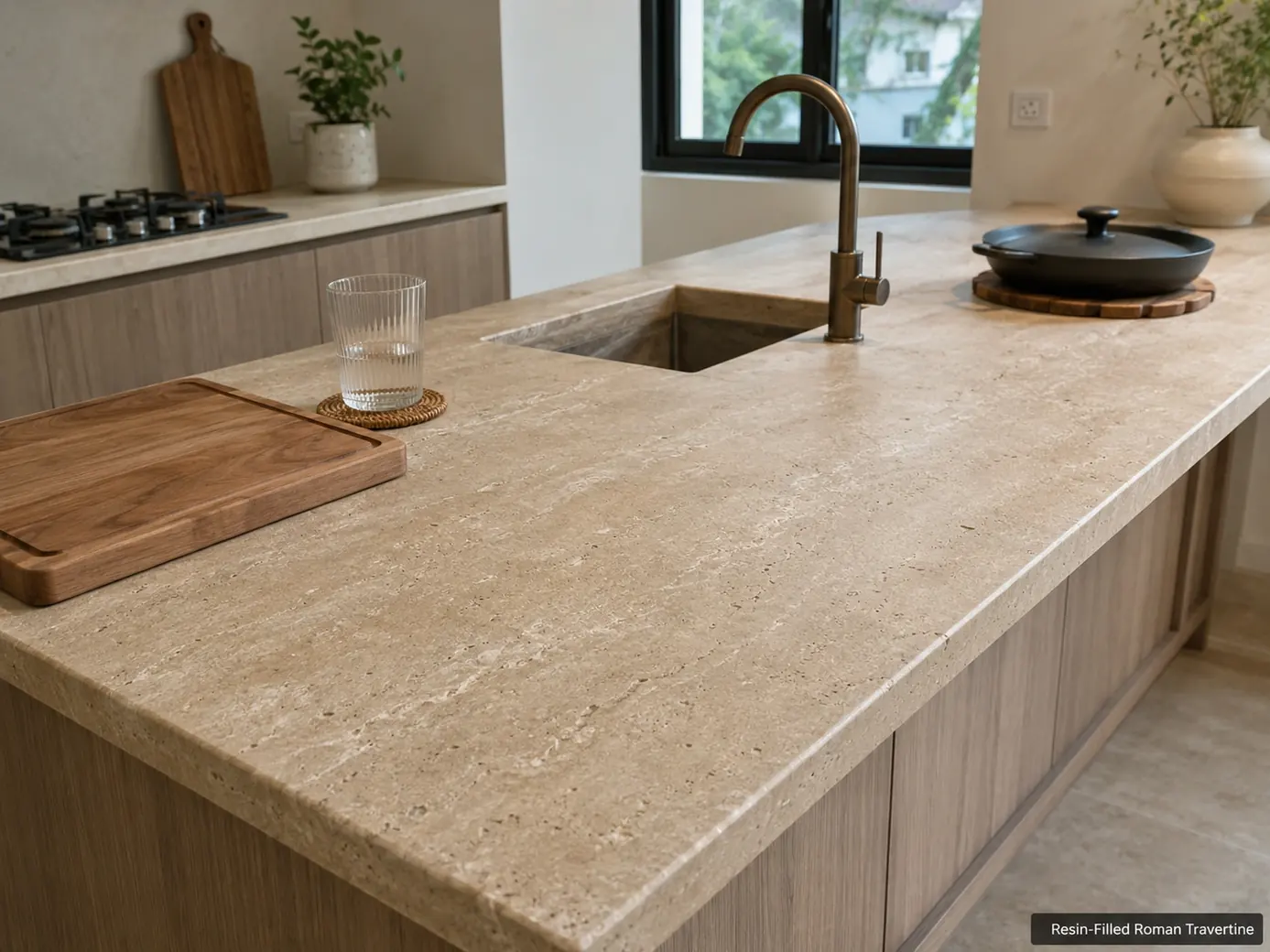
A travertine top can work for a kitchen when the owner accepts that calcium-carbonate stone may etch from lemon, vinegar and wine and can absorb staining liquids. Travertine kitchen countertops are heat-tolerant natural stone surfaces, but trivets remain sensible for hot cookware. Honed, filled and polished treatments are available, and edges, sinks, thickness and dimensions can be fabricated to order. Impregnation improves stain resistance but does not make travertine stain-proof or acid-proof.
Travertine Surface Guide
Travertine Countertop Small
Secure product inquiry
Buy now
Cash on delivery available. Product details are pre-filled below. Owner delivery adds AED 5,000.
Seal, Heat & Edge Fabrication
From Slab Selection to Installed Worktop
This 120 × 60 × 3 cm resin-filled Roman travertine worktop can be fabricated with sink or cooktop openings and customised edge profiles before installation. The filled honed surface reduces open cavities, but it remains a porous calcium-based stone that benefits from penetrating sealer. Heat is generally manageable, while citrus, vinegar, wine and other acidic spills should be removed immediately to limit etching and staining.
Natural Stone Worktop
Filled Roman Travertine Kitchen Counter
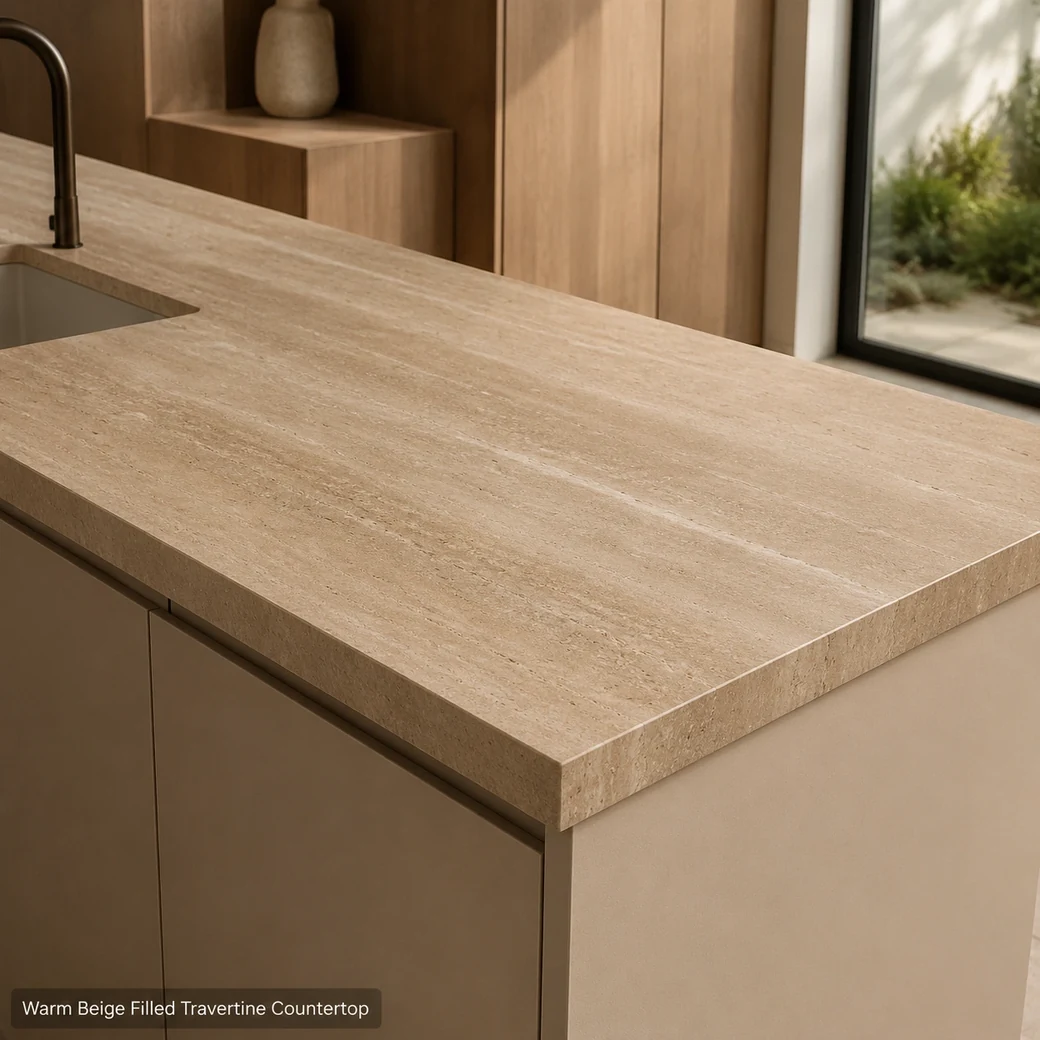
The Filled Roman Travertine Kitchen Counter is a 120 × 60 × 3 cm fabricated worktop made from resin-filled Roman travertine with a honed finish. Its warm beige surface and cream veining create a natural-stone working plane suited to kitchens, bathroom vanities, bar counters and similar custom installations. At 54 kg, the piece requires appropriately supported cabinetry or framing, while the resin-filled treatment creates a more continuous working surface than naturally open-pored travertine without removing the material’s characteristic stone variation.
Countertop Fabrication
How to Specify a Travertine Work Surface
The 120 × 60 × 3 cm travertine work surface should first be defined as either a full slab system or a tiled installation because the two rely on different jointing and support strategies. A 30 mm slab can create a continuous fabricated worktop, while tiles introduce multiple joints and depend heavily on the backing bed; in both cases, cabinet or substrate support must be planned around the stone weight, cutouts and unsupported spans.
Fabricate Openings in a Stone Kitchen Worktop
Sink and cooktop openings should follow precise appliance templates, preserve reinforced stone around vulnerable edges and maintain the manufacturer’s required clearances.
Choose the Right Travertine Counter Edge
Eased edges give a restrained profile, bevels sharpen the geometry and bullnose edges soften exposed corners, with other profiles fabricated to the project detail.
Protect a Natural Stone Kitchen Counter
Impregnation can reduce liquid absorption and staining, but it cannot stop acidic lemon, vinegar or wine from etching calcium-based travertine.
Product Data
Roman Travertine Countertop Product Details
This small-category countertop uses resin-filled Roman Travertine with a honed finish and filled warm-beige colouring with cream veining. Its 120 × 60 × 3 cm dimensions and 54 kg weight create a substantial 30 mm worktop intended for supported kitchen or similar countertop fabrication.
| Sink Cutout Radius | Minimum R15 mm internal sink-cutout corner radius |
|---|---|
| Cooktop Cutout Clearance | Minimum 50 mm stone bridge between cooktop cutout and nearest free edge; final opening to appliance template |
| Edge Profile | 3 mm eased top and bottom edges on the exposed 30 mm countertop perimeter |
| Overhang Limit | Maximum 300 mm unsupported overhang for the 30 mm stone top; longer projections require engineered steel support |
| Seam Position | Position seams over fully supported cabinet divisions and keep them away from sink or cooktop cutout corners |
| Underside Reinforcement | Recessed steel support rails beneath cutouts, narrow stone bridges, seams and unsupported projections exceeding 250–300 mm |
| Faucet Hole Diameter | Ø35 mm faucet hole for a standard single-hole mixer; final drilling must follow the selected tap template |
| Backsplash Joint Detail | 2–3 mm flexible sanitary-sealant joint between the countertop and matching backsplash |
| Cabinet Bearing Width | Minimum 50 mm continuous cabinet or structural bearing beneath the countertop perimeter and supported joints |
| Fabrication Tolerance | Finished length and width within ±2 mm, thickness within ±1 mm and cutout position within ±1.5 mm of the approved template |
Custom Worktop Service
Bespoke Travertine Counter Fabrication
Bespoke fabrication can position sink cutouts, cooktop openings and faucet holes from approved appliance templates while maintaining safe stone bridges and rounded internal corners. Counter length, depth, thickness, edge profile and backsplash height can all be project-cut, with seams and reinforcement planned before the slab is processed.
Kitchen Applications
Where to Use a Travertine Stone Worktop
A travertine stone worktop is best suited to kitchen islands, bar counters, vanity surfaces, serving counters and other interiors where natural texture is valued and routine stone care is acceptable. Its ability to accept custom sink openings, edge profiles and dimensions makes it particularly useful for bespoke fitted surfaces.
- Kitchen Counter Surfaces
Filled and honed travertine can be fabricated into bespoke kitchen counters with custom edges, sink openings and dimensions.
- Bathroom Vanity Tops
Filled and honed travertine can be fabricated into bathroom vanity tops with custom basin openings, edges and dimensions.
- Custom Bar Worktops
Travertine worktops can be fabricated to custom bar dimensions with tailored edges, openings and service cut-outs.
- BBQ Counter Options
Custom travertine worktops can be fabricated for BBQ counters with tailored dimensions, edges and appliance or sink openings.
Daily Surface Care
Maintaining a Filled Travertine Counter
Use trivets beneath hot cookware and wipe wine, oils or strongly coloured spills immediately, while recognizing that lemon and vinegar can etch filled travertine even when the surface has been sealed. Maintain the honed counter with a pH-neutral cleaner and reassess impregnation periodically according to absorption and use; alternative fabricated surfaces available through a corian supplier in uae have different chemical and maintenance characteristics, so care instructions should always match the actual material.

Technical Specification
Travertine Worktop Specifications
Use the worktop specifications to confirm the filling treatment, edge detail, required cutouts and sealing provision before fabrication begins. These fields allow your fabricator to coordinate sinks, appliances and exposed edges accurately while ensuring the finished countertop is prepared for its intended kitchen layout.
Product details
Specifications, care, delivery and FAQ
Everything is rendered from product JSON fields so the page remains SEO-ready even before JavaScript runs.
Cleaning: Remove crumbs with microfiber, blot citrus vinegar wine oil and coffee immediately, clean honed filled travertine using pH-neutral stone cleaner, rinse sparingly and dry, clean sink rails and seams with a soft brush, avoid acidic disinfectants abrasives and direct hot cookware
Daily Care: Use cutting boards coasters and trivets, blot citrus vinegar wine oil and coffee immediately, wipe honed filled travertine with pH-neutral stone cleaner, dry around sink rails and seams, inspect filler regularly, avoid acidic disinfectants abrasives and direct hot cookware
- Avoid narrow unsupported rails around sink cutouts
- avoid citrus vinegar or wine remaining
- avoid direct hot cookware
- avoid abrasive or acidic cleaners
- avoid standing on the countertop
Maintenance: Use cutting boards trivets and coasters, blot acidic or oily spills immediately, clean honed filled travertine with pH-neutral stone cleaner, dry sink rails and joints, inspect filler and reinforcement, reassess impregnation when absorption increases
Handling: Use professional fabricators for the 54 kg top, carry it vertically on an A-frame, reinforce and support sink cutouts, use compatible suction lifters, protect narrow front and rear rails, never lift through openings or unsupported ends
How can an etched area on this honed filled-travertine countertop be professionally repaired so the affected patch matches the surrounding sheen instead of looking polished or dull?
A professional repair begins by identifying whether the mark is true acid etching, a stain or damaged filler. For honed filled Travertine, the affected area is normally cleaned, damaged filler replaced if necessary, then progressively honed with suitable diamond abrasives to reproduce the surrounding low sheen. Polishing only the spot will create a glossy patch, while overly coarse treatment leaves it dull. The technician should blend beyond the visible edge and test on an inconspicuous area; sealer may be reapplied afterward but cannot remove etching or change mismatched sheen.
Will the resin-filled pores around the sink remain intact under long-term exposure to water, soap and routine countertop cleaning?
High-quality factory filler can remain stable around a sink when it is properly bonded, fully cured and compatible with wet countertop use, but repeated saturation, harsh chemicals, heat and movement may eventually loosen or discolor weak repairs. Inspect filled pores for gaps before installation, provide correct sink support and seal stone-to-sink joints with flexible sanitary sealant rather than relying on filler. Use pH-neutral cleaner, prevent standing water and monitor repairs periodically. Any cracked or detached filler should be removed and professionally replaced rather than covered with additional sealer.
How durable is a mitred travertine countertop edge against daily kitchen impacts, and what internal reinforcement should support it?
A mitred edge creates a substantial appearance but its exposed corner can chip under repeated impact if poorly supported. Use a continuous internal buildup strip or engineered backing bonded behind both mitred faces, avoid hollow sections, slightly ease the external corner and keep cabinet or frame support directly beneath critical edges.
How much structural reinforcement is required around a sink cutout in the 30 mm Travertine Countertop, particularly across narrow stone rails at the front and rear?
The narrow front and rear rails around a sink need continuous cabinet or steel-subframe support, with concealed stainless-steel bars or engineered reinforcement channels where the fabricator approves them. Avoid relying on 30 mm travertine to bridge the opening unsupported, use generous internal corner radii, keep joints away from the cutout and support the sink independently so its filled weight does not hang from fragile stone rails.
How should a water-drop test be performed on this honed travertine countertop, and how quickly must the water darken the stone before resealing should be considered?
Clean and dry an inconspicuous area, place several coin-sized drops of water on it and time any darkening without rubbing. Absorption or darkening within about 5–10 minutes suggests resealing may be useful, while water remaining beaded with little colour change for 15–30 minutes indicates adequate resistance; compare several locations and allow the stone to dry completely afterward.
Reviews
Reviews and new review submission
0.0 average rating from 0 reviews. New reviews are saved as pending until approved.
No approved reviews yet for this product. The review form is ready for buyer submissions.