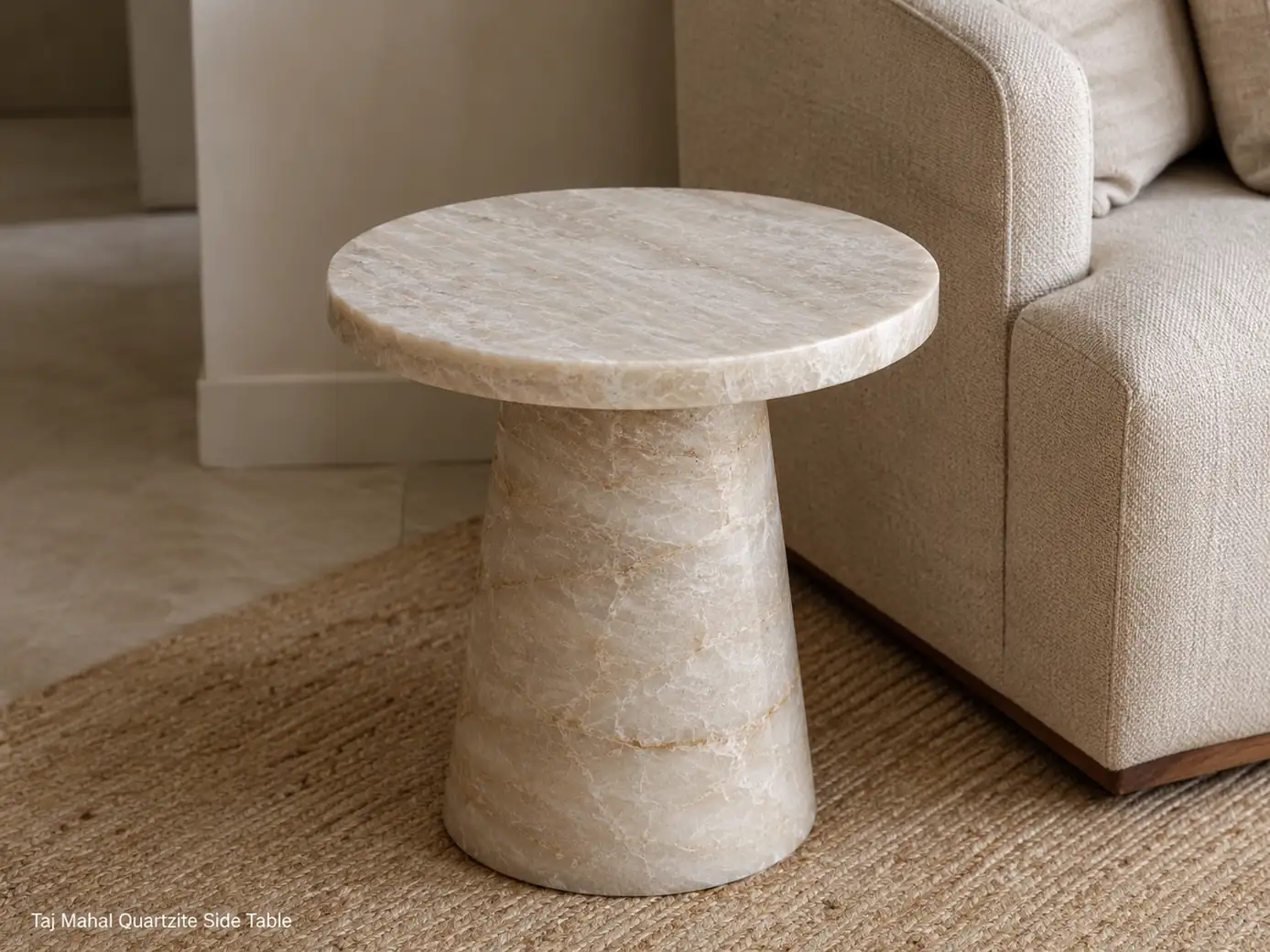
Quartzite is excellent for a side table because it is generally harder and more scratch-resistant than marble while retaining natural veining. The finished table remains heavy due to stone density, so transport should be planned carefully. Bespoke tops, pedestals and dimensions can be fabricated, with polished, honed, brushed or leathered-style finishes depending on the slab. Maintain quartzite furniture with mild stone cleaner and avoid highly acidic or abrasive chemicals.
Quartzite Furniture Performance
Quartzite Side Table Small
Secure product inquiry
Buy now
Cash on delivery available. Product details are pre-filled below. Owner delivery adds AED 5,000.
Custom Quartzite Craftsmanship
Natural Hardness Meets Bespoke Furniture Design
Taj Mahal Quartzite offers a harder, more scratch-resistant surface than typical marble, making it well suited to compact furniture that receives regular handling. This Ø42 × 50 cm table can be customised with round, square or irregular tops, brushed, honed or polished finishes and bespoke edge profiles. Metal, timber, brass or glass details can be incorporated without losing the natural crystalline character.
Hard Natural Stone Furniture
Natural Quartzite Side Table Material Performance
A Natural Quartzite Side Table made from Taj Mahal Quartzite combines a brushed warm cream-beige surface with soft gold veining and greater inherent hardness than typical marble. That difference matters in an everyday occasional table because quartzite is generally more resistant to scratching and surface wear while still providing the flowing natural movement associated with decorative stone. The brushed finish softens reflection and emphasizes the warmer mineral texture, making Taj Mahal Quartzite a strong choice where marble-like elegance is desired but a harder natural stone is preferred for regular use.
Custom Shape & Edge
Quartzite Accent Table Sizes and Bespoke Forms
This Ø42 × 50 cm quartzite accent table weighs 30 kg, giving it a compact but substantial form for beside-chair or bedside placement. The same material can be fabricated into round, square, rectangular or irregular tops depending on the available floor area and design intent, while the base geometry should be adjusted with the top so the finished piece remains proportionate and stable.
Quartzite Top Side Table Bevel and Bullnose Options
A softly eased or pencil edge suits the brushed Taj Mahal Quartzite top by protecting exposed edges without hiding its natural 42 cm profile.
Quartzite Pedestal Table with Brass, Wood or Metal
Steel or brass creates a lighter visual base, while solid timber or stone gives the 30 kg Taj Mahal Quartzite table a heavier, more grounded character.
Blue and Green Quartzite Side Table Alternatives
Taj Mahal Quartzite offers a warm cream-and-gold option, while alternative quartzites can be selected when a darker, stronger or more dramatic natural pattern is preferred.
Product Overview
Taj Mahal Quartzite End Table Details
This end table uses Natural Taj Mahal Quartzite with a brushed Warm Cream Beige surface and Soft Gold veining, measuring Ø42 × 50 cm and weighing 30 kg. The supplied data does not state the exact top thickness, fabricated edge profile or base material, so those items should be confirmed from the shop drawing rather than assumed.
| Top Thickness | 20 mm Taj Mahal Quartzite top. |
|---|---|
| Base Material | Powder-coated structural-steel pedestal; AISI 304 stainless steel preferred for humid interiors |
| Support Plate Diameter | Approx. Ø28 cm concealed support-plate diameter beneath the quartzite top |
| Edge Profile | R3 mm pencil edge around the exposed quartzite top perimeter |
| Distributed Load Rating | 40 kg uniformly distributed load across the Ø420 mm top, with a 15 kg maximum concentrated decorative load near the centre. |
| Floor Pad Type | Replaceable 3 mm clear silicone or non-marking thermoplastic-rubber floor pads |
| Leveling Provision | Concealed adjustable floor glides providing approximately 8 mm vertical correction |
| Assembly Method | Three concealed M8 stainless-steel bolts through the pedestal mounting plate into epoxy-set threaded inserts beneath the Ø420 mm top. |
| Underside Reinforcement | Recessed 5 mm stainless-steel support plate bonded beneath the quartzite top |
| Top-to-Base Fastener | Three M8 A4 stainless-steel bolts through the pedestal cap into resin-set inserts beneath the Ø420 mm quartzite top. |
Durability & Care
Maintaining a Natural Quartzite Accent Table
Natural quartzite generally resists scratching and acid etching better than marble, but it should still be protected from harsh chemicals and abrasive cleaning. Use a stone-safe neutral product and lift the heavy table with adequate assistance rather than pulling it across the floor.
Furniture Performance
Why Choose a Quartzite Crystal Side Table
A quartzite crystal side table offers four factual strengths: quartzite is generally harder than marble, resists scratching well in normal furniture use, retains natural veining for decorative appeal, and can be fabricated into custom tops or pedestals with brushed, polished or honed finishes.
- Hard Natural Surface
Taj Mahal quartzite provides a naturally hard, scratch-resistant tabletop suited to frequent side-table use.
- Soft Gold Veining
Taj Mahal quartzite displays soft gold veining across a warm cream surface while retaining genuine natural variation.
- Custom Edge Profiles
Taj Mahal quartzite can be fabricated with custom edge profiles to match the selected pedestal and furniture design.
- Bespoke Base Options
Bespoke stone, metal or engineered pedestal bases can be designed to support the Taj Mahal quartzite top and match the interior concept.
Made to Order
Custom Quartzite Table Options
A custom quartzite table can be fabricated to bespoke dimensions with top thickness typically selected within roughly 20–50 mm according to span, edge design and structural support. Taj Mahal Quartzite can be finished polished, honed, brushed or leathered-style, with straight, bevelled, mitred or other edges and sculptural stone or mixed-material bases; the same precision in cutting and finishing applies to architectural elements such as a stone sill.

Technical Reference
Taj Mahal Quartzite Furniture Specifications
Use the furniture specifications to confirm top thickness, edge treatment and base construction before finalizing the table design. These fields help you understand how the quartzite top is fabricated and supported while giving you a clear care reference for long-term use.
Product details
Specifications, care, delivery and FAQ
Everything is rendered from product JSON fields so the page remains SEO-ready even before JavaScript runs.
Cleaning: brush dust from the textured finish, blot drink and oil spills promptly, clean with mild pH-neutral stone cleaner, rinse sparingly and dry along the veins, avoid strong acids abrasives and wax
Daily Care: Use coasters trivets and padded décor, remove grit before moving items, blot drinks oils and pigments promptly, wipe quartzite with pH-neutral stone cleaner, dry without residue, avoid harsh chemicals abrasives and striking vulnerable edges
- Avoid harsh chemicals
- avoid direct hot items without trivets
- avoid dragging accessories
- avoid concentrated edge impacts
- avoid moving the table without protecting its base and flooring
Maintenance: Use coasters trivets and padded décor, remove grit before shifting items, blot stains promptly, clean quartzite with pH-neutral stone cleaner, inspect supports and edge chips, reassess sealing only when absorption testing indicates
Handling: Clear the tabletop, lift from beneath the engineered base, support the quartzite top, pad corners, set down evenly on floor protectors, never drag or strike exposed edges
How can I verify that the Taj Mahal stone used for this side table is genuine quartzite rather than a softer marble or dolomitic stone sold under the same commercial name?
“Taj Mahal” is a commercial name applied inconsistently, so verify the actual slab rather than relying on the label. Genuine quartz-rich stone should resist scratching from a steel blade on an inconspicuous offcut and should not fizz or visibly etch when a stone professional performs a controlled acid test; calcitic marble reacts more readily. Some dolomitic stones may pass simple household tests, so request geological classification, supplier documentation and petrographic analysis when authenticity affects price or performance. Never perform damaging tests on the finished table.
Does a brushed Taj Mahal quartzite surface require more frequent sealing than the same stone with a polished finish?
A brushed Taj Mahal quartzite surface usually needs testing more frequently than a polished surface because its textured finish provides more exposed area and may retain spills more readily. This does not automatically mean frequent sealing; perform a water-absorption test every 6–12 months and reseal only when noticeable darkening occurs.
Which edge profile best protects a small round quartzite side-table top from accidental chips?
A small eased or rounded edge of about 3–5 mm provides the best balance of chip resistance and a clean profile on a small round quartzite top. A sharp square edge is vulnerable, while a full bullnose changes the appearance substantially; the fabricator should avoid placing natural fissures at the perimeter.
How should the Quartzite Side Table’s base provide continuous support beneath the dense stone top without creating concentrated pressure points that could cause cracking?
Support the Ø42 cm quartzite top on a flat circular subplate or rigid frame that bears across a broad central area, using a thin continuous layer of neutral-cure stone-compatible silicone or resilient isolation material. Avoid isolated bolts, hard metal tabs or uneven pads directly against the stone, and mechanically connect the subplate to the pedestal so fastening pressure is distributed rather than concentrated near drilled holes.
Can the direction and placement of the quartzite veins be selected before fabrication so the finished side table has a balanced pattern from its primary viewing angle?
Yes, vein direction and placement can be selected before fabrication by overlaying a full-scale tabletop template onto a calibrated photograph of the actual Taj Mahal Quartzite slab. Mark the primary viewing angle, preferred vein flow, edge position and pedestal centre, then approve the labelled digital layout before cutting; minor adjustments may still be necessary to avoid fissures or structurally weak slab areas.
Reviews
Reviews and new review submission
0.0 average rating from 0 reviews. New reviews are saved as pending until approved.
No approved reviews yet for this product. The review form is ready for buyer submissions.