An onyx slab is commonly supplied around 18–20 mm for decorative panels and about 30 mm where greater horizontal strength is required, although custom thicknesses exist. Its translucency makes backlighting possible, but natural fissures mean careful reinforcement and fabrication are important. Available colours include green, honey, white, pink, blue, brown and multicolour. Impregnation can reduce staining, and typical uses include walls, bars, vanities, tables and illuminated features.
Natural Onyx Surfaces
Onyx Slab Small
Secure product inquiry
Buy now
Cash on delivery available. Product details are pre-filled below. Owner delivery adds AED 5,000.
Bookmatching, Reinforcement & Light
Selecting Onyx for Vein Continuity and Translucency
This 180 × 90 × 2 cm green onyx slab should be selected not only for colour but also for translucency, fissure pattern and how neighbouring slabs continue the vein movement. Resin and mesh reinforcement are common because onyx is more fragile than granite. For illuminated walls or counters, sequential slab availability becomes especially important when bookmatching or continuous visual flow is required.
Architectural Stone Selection
Natural Green Onyx Slab Color and Translucency
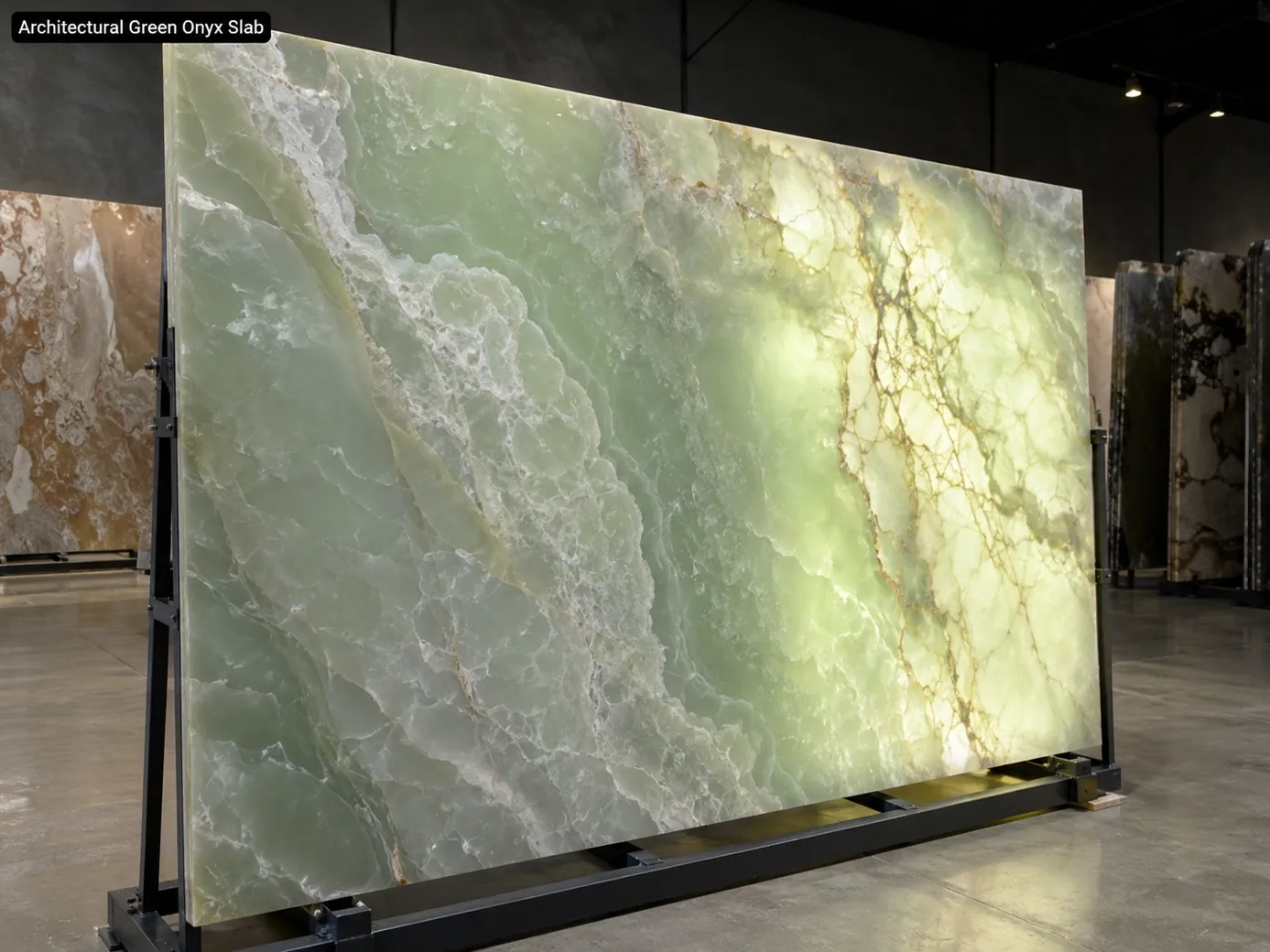
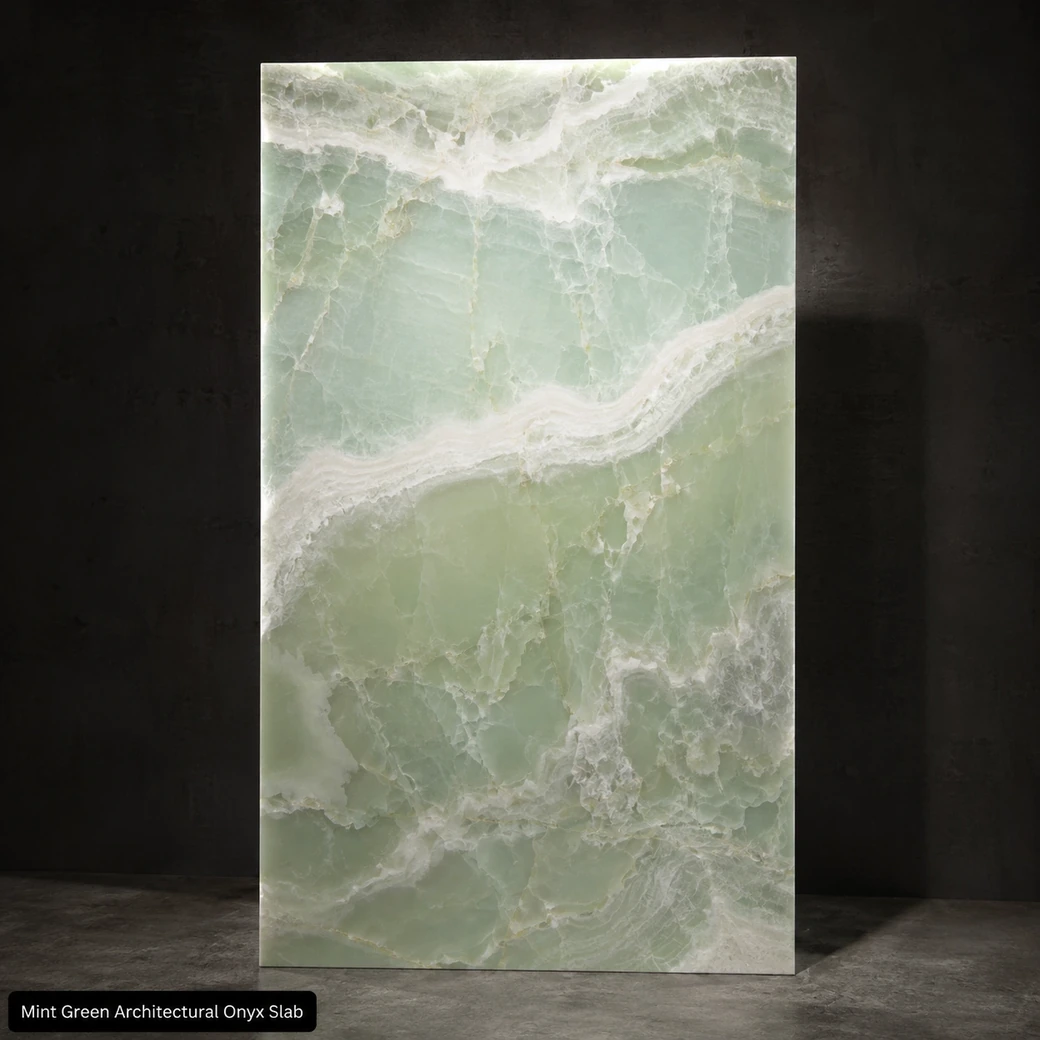
Natural Green Onyx slabs are selected as much for how they transmit light and move visually across the surface as for basic dimensions or color. Architectural Onyx Stone with a polished soft mint-green background and milky bands can reveal natural fissures, layered mineral zones and changing translucency across a single slab. Those characteristics become especially important when pieces will be bookmatched, illuminated or fabricated into large decorative features, because the position and direction of each vein can determine how successfully adjoining sections continue the natural pattern.
Thickness & Matching
Translucent Onyx Stone Slab Sizes and Bookmatching
The 180 × 90 × 2 cm Green Onyx slab weighs 87.5 kg and uses the approximately 20 mm thickness common for decorative slab fabrication. For bookmatched work, slabs should be selected from sequential cuts so adjacent faces can be opened together and their bands continue or mirror across the joint; this pairing should be planned before trimming because cutting individual slabs independently can destroy the intended pattern relationship.
Polished Onyx Slab Resin and Mesh Support
Reinforcement should support natural fissures and fragile zones across the 20 mm onyx slab during handling, cutting and final installation rather than relying on the stone alone.
Backlit Green Onyx Slab Applications
Backlighting should be tested on the actual 20 mm slab because milky bands and denser green areas will transmit different amounts of light across the surface.
Natural Onyx Stone Slab Vein Matching
Select the slab by viewing the full 180 × 90 cm face for translucency, fissures, mint tone and milky band distribution before deciding its final application.
Product Overview
Mint Green Onyx Slab Details
This polished Architectural Green Onyx slab has a soft mint-green field with milky bands, measures 180 × 90 × 2 cm and weighs 87.5 kg. Its 20 mm stone can transmit light and may require reinforcement around natural fissures; exact reinforcement method and availability of matched companion slabs are not specified.
| Bookmatch Availability | Available as sequential A/B mirrored bookmatch pair |
|---|---|
| Bundle Sequence | Sequential same-bundle numbering with adjoining slabs reserved as A/B bookmatch pairs |
| Slab Flatness Tolerance | Maximum 3 mm total bow over the full slab length when measured with a straightedge before fabrication |
| Edge Squareness | Maximum 1.5 mm deviation from square over each metre of finished slab edge |
| Light Transmission Percentage | Approx. 5–15% visible-light transmission depending on slab thickness, mineral density and vein structure; confirm using a full-size illuminated sample |
| Light-Diffusion Uniformity | Illumination system designed to keep visible brightness variation within approximately ±10% across the approved sample area |
| Usable Fabrication Area | Net usable fabrication area excludes a minimum 20 mm perimeter trim and all digitally mapped fissures, repairs or opaque inclusions |
| Factory Mesh Presence | Factory-applied fibreglass mesh backing where required by fissures and handling risk; mesh presence must be declared for each slab |
| Resin Tone | Use clear or stone-toned non-yellowing resin matched to the slab’s lightest translucent background |
| Cut Orientation | Cut primary pieces parallel to the approved vein direction; bookmatched panels must alternate consecutive slab faces according to the numbered layout |
Fabrication & Care
Handling a Translucent Onyx Slab Safely
Translucent onyx is fragile and should be transported vertically on a protected frame, lifted by specialists and cut using a planned fabrication sequence. Resin or mesh reinforcement may support fissured areas, while finished surfaces should be sealed where appropriate, cleaned softly and protected from point impacts throughout handling.
Architectural Value
Why Choose a Backlit Onyx Slab
A backlit onyx slab offers four project advantages: large-format stone creates fewer visual interruptions, translucency allows integrated lighting, custom thickness can be selected for decorative or horizontal use, and the slab can be fabricated into walls, bars, vanities, tables or illuminated architectural features. Reinforcement and careful handling remain important because natural onyx may contain fissures.
- Natural Light Transmission
The translucent green onyx slab can transmit backlighting through thinner sections to reveal its internal milky banding.
- Bookmatch Vein Potential
Large-format onyx slabs can be paired and mirrored to create dramatic bookmatched vein patterns across feature surfaces.
- Luxury Feature Applications
Large green onyx slabs suit luxury feature walls, illuminated bars, vanities, tables and other statement interior applications.
- Sequential Slab Matching
Sequential slabs can be selected and aligned to continue related mineral bands across larger decorative installations.
Project Fabrication
Custom Architectural Onyx Stone Options
Architectural onyx can be cut to size for vanity tops, furniture, wall panels or illuminated features, with sequential slabs selected where continuous vein movement is important. Translucent applications should coordinate backlighting and reinforcement before fabrication, while fragile edges and fissures require protective packing, upright transport and specialist handling; unlike routine cleaning questions such as how to remove rust stain from laminate countertop, natural onyx demands careful planning from fabrication through delivery.

Technical Reference
Natural Green Onyx Stone Specifications
Review the slab specifications for reinforcement, translucency and recommended applications before assigning the stone to furniture, wall panels, vanities or illuminated features. The sealing and reinforcement fields are especially useful when deciding how the selected slab should be fabricated and supported.
Product details
Specifications, care, delivery and FAQ
Everything is rendered from product JSON fields so the page remains SEO-ready even before JavaScript runs.
Cleaning: Dust with clean microfiber, wipe polished onyx using a lightly damp cloth and pH-neutral stone cleaner, blot colored or oily spills immediately, rinse minimally and buff dry, test products on an offcut, avoid acids abrasives solvents thermal shock and prolonged moisture
Daily Care: Dust polished onyx with clean microfiber, blot colored oily or acidic spills immediately, wipe using pH-neutral stone cleaner, buff dry, protect edges and unsupported areas, use padded accessories, avoid acids abrasives solvents heat shock and heavy impact
- Avoid unsupported spans or cutouts
- avoid acids and colored spills
- avoid abrasive tools
- avoid rapid thermal changes
- avoid lifting the fragile slab without full-frame support
Maintenance: Store vertically on a full-support rated frame, use padded spacers between faces, inspect fissures and translucent weak zones, clean with pH-neutral stone cleaner, protect finished edges, document slab orientation before cutting or relocation
Handling: Use a rated A-frame and certified lifting equipment, carry vertically with full edge support, protect fissures and translucent weak areas, use padded restraints, keep the slab upright during transport, never lift it flat or through cutouts
Do resin-filled fissures in a Green Onyx slab indicate normal reinforcement or lower quality, and how can I judge whether the repaired areas remain suitable for fabrication and backlighting?
Resin-filled fissures are common in Green Onyx because the stone is naturally brittle and often reinforced during processing; their presence does not automatically indicate unacceptable quality. Judge the slab by resin colour stability, adhesion, repair width, mesh backing, flatness and whether fissures intersect critical cut-outs or unsupported edges. For backlighting, illuminate the entire slab before purchase because repairs may appear darker, cloudier or more reflective. The fabricator should map repaired zones and avoid placing heavily filled areas at narrow bridges, mitres or fixing points.
Should the fibreglass mesh backing remain attached while this onyx slab is cut and fabricated, or must it be removed from finished bonding areas?
Mesh backing should normally remain attached during handling and cutting because it reinforces the brittle slab. Removal may be necessary only where the specified adhesive cannot bond reliably to the mesh or resin, along mitres, seams or other fabricated bonding zones. The fabricator should grind back those local areas carefully rather than stripping the entire slab without guidance. Confirm compatibility among mesh resin, backing adhesive and substrate through testing, especially for backlit work where uneven remaining resin may create visible shadows.
How should consecutive onyx slabs be inspected and selected to create a symmetrical bookmatched feature wall with balanced colour and translucency?
Inspect consecutive slabs under transmitted light because surface viewing alone will not reveal translucency differences. Photograph, number and virtually mirror each slab around the proposed centre line, aligning dominant veins and colour fields; reserve matching adjacent slabs and test the final bookmatch using the intended backlighting system.
Which transparent backing system—laminated glass, acrylic honeycomb or another reinforced substrate—best supports the Green Onyx Slab while preserving even light transmission?
Laminated low-iron glass is generally the strongest transparent backing for an 87.5 kg illuminated Green Onyx Slab because it provides continuous structural support while preserving colour and light transmission. The onyx should be bonded with an optically clear, non-yellowing, stone-compatible interlayer or silicone system; acrylic honeycomb is lighter but may print its cell pattern through the stone, so any backing, adhesive and LED spacing must be tested on a full-size illuminated sample before fabrication.
How should an onyx slab be inspected under both ordinary reflected light and full backlighting to assess colour, fissures, repairs, thickness and translucency before purchase?
Examine the slab upright under consistent front lighting for polish, colour, repairs, fissures and surface resin, then illuminate the complete back with the intended LED colour and diffuser distance. Mark dark zones, weak areas, variable thickness and structural repairs, inspect both faces and edges and approve the exact cut layout before purchase rather than selecting from one small backlit sample.
Reviews
Reviews and new review submission
0.0 average rating from 0 reviews. New reviews are saved as pending until approved.
No approved reviews yet for this product. The review form is ready for buyer submissions.