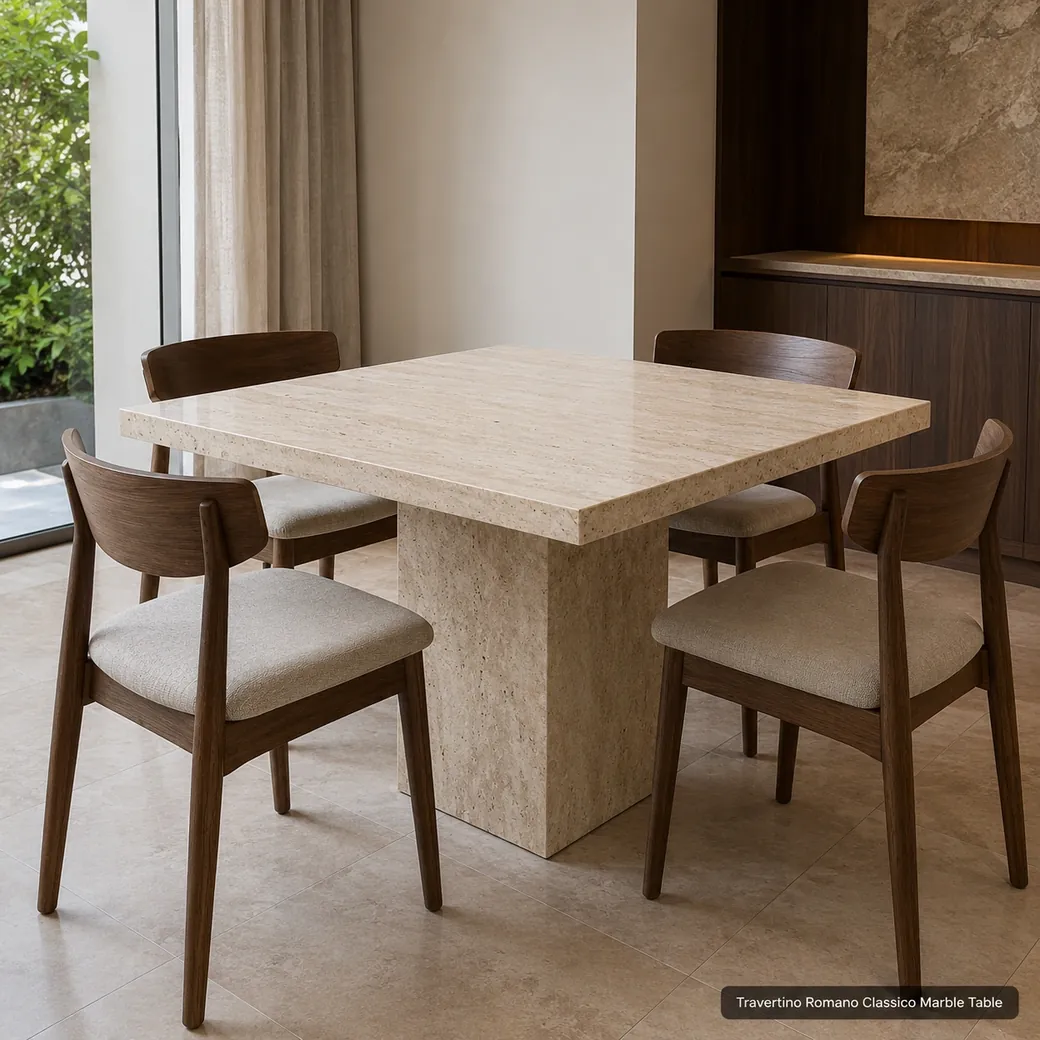
Tables with a stone top can use round, rectangular or bespoke formats, including a Marble Table with Brass Stand, Marble Table with Gold Base or Round Marble Table with Brass Column. Top thickness depends on span, support and fabrication, so it should be engineered rather than chosen by appearance alone. Natural stone is durable but benefits from coasters, trivets and appropriate sealing where needed, with pH-neutral cleaning for daily care.
Custom Natural Stone Table Design
Marble Table Small
Secure product inquiry
Buy now
Cash on delivery available. Product details are pre-filled below. Owner delivery adds AED 5,000.
Edge Profiles & Base Pairing
Choosing Stone, Thickness and Edge Profile
Natural-stone tables can be specified with 20 mm, 30 mm or heavier 40 mm-plus tops depending on scale, structure and desired visual weight. Bevelled, chamfered, rounded and ogee edges change both the appearance and how exposed the perimeter is to impact, while full-stone, timber, brass or stainless-steel bases alter load distribution. For this 90 × 90 × 75 cm travertine table, final support design should account for its substantial 92 kg total weight and installation access.
Table Planning
Choosing the Right Natural Stone Table
Start with the table’s actual role: a dining table needs comfortable seating positions and leg clearance, an occasional table can prioritize a compact footprint and visual impact, and a general-use table may need greater flexibility for work, serving or display. Once the use is defined, tabletop size and base geometry can be chosen to support that activity without obstructing circulation.
Design Formats
Travertine Pedestal Table Configurations
A round travertine table improves circulation and centres seating around one point, while rectangular formats create more usable edge length. Brass bases introduce a refined metallic contrast, wood bases soften the stone visually, and full-stone constructions deliver the strongest architectural presence but require substantially more consideration for weight, handling and floor loading.
Stone Tabletop Thickness and Edge Profile
Use 20 mm where span and support permit, move to 30 mm or thicker fabrication for greater visual mass or structural demand, and coordinate edge treatment with the supporting base.
Brass Base Table Structural Support
A full pedestal gives concentrated central support, metal or timber reduces visual mass, and modular bases simplify transport or replacement while still needing adequate support beneath the travertine top.
Roman Travertine Dining Surface Protection
Protect the Roman Travertine with coasters and trivets, use impregnation where absorption warrants it and clean only with pH-neutral stone products.
Product Data
Natural Beige Stone Table Details
This small table uses honed Travertino Romano Classico in natural Roman Travertine with natural beige colouring and cream linear veins. Measuring 90 × 90 × 75 cm and weighing 92 kg, it is a substantial square dining-height stone table whose support must distribute the finished load appropriately.
| Base Connection Detail | 4 × M10 stainless threaded inserts secured to steel mounting plate |
|---|---|
| Leg Clearance | Approx. 680 mm clear legroom height |
| Apron Clearance | 680 mm clear vertical apron clearance above finished floor level |
| Top Flatness Tolerance | Maximum 1.5 mm surface deviation under a 1.2 m straightedge |
| Base Levelling Adjustment | Four concealed M10 levelling feet providing ±10 mm adjustment |
| Floor Protection Pads | 3 mm-thick felt-backed EPDM floor-protection pads beneath all contact points |
| Knock-Down Assembly Type | Demountable M10 bolt-and-threaded-insert assembly with concealed locating dowels |
| Base Material Gauge | 40 × 40 × 2 mm powder-coated structural-steel base sections |
| Seating Edge Clearance | Minimum 300 mm horizontal clearance from the table edge to any base obstruction |
| Vein Orientation | Primary vein direction aligned along the tabletop length and matched across fabricated sections |
Made to Order
Custom Italian Stone Table Options
Custom Italian-stone tables can be produced to the required length, width and seating capacity with straight, bevelled, rounded or profiled edges. Base material, metal finish and stone selection should be finalized alongside the support layout so the top span and finished weight remain properly engineered.
Key Benefits
Why Choose This Bespoke Pedestal Table
This bespoke pedestal table allows the stone top, base geometry, span and thickness to be engineered together rather than selected as unrelated parts. Buyers can specify round, rectangular or custom dimensions, edge details and brass, metal or stone pedestal configurations, creating a table that fits the room while maintaining the structural support required by the Travertine top.
- Natural Stone Surface
The Roman Travertine top provides a genuine natural-stone work and dining surface whose dimensions, edge profile and support can be engineered together.
- 92 kg Stability
The 92 kg Travertine construction gives the dining surface substantial stability when paired with correctly engineered support beneath the stone top.
- Multiple Base Options
Stone pedestal, brass, gold-tone or other engineered base options can be paired with the Travertine top to suit different structural and design requirements.
- Custom Edge Profiles
Straight, bevelled, eased, bullnose or other edge profiles can be fabricated to change both the tabletop’s visual weight and everyday edge feel.
Purchase Guidance
Before Ordering a Marble Table UAE
Before ordering a Travertine marble table in the UAE, measure the room and circulation area so the 90 × 90 cm top does not crowd surrounding seating or walkways. Confirm the engineered top thickness, desired stone, brass, steel or other base design, delivery route for the 92 kg piece and whether the Travertine requires an impregnating sealer for the intended use; comparable coordination is important for professional stone installation toronto.

Specification Reference
Travertine Table Technical Specifications
The specification table should confirm the 90 × 90 × 75 cm dimensions and 92 kg weight together with tabletop thickness, edge profile, supporting base material and honed Travertine finish so you can verify structural support, room fit and the exact stone or metal base configuration before ordering.
Product details
Specifications, care, delivery and FAQ
Everything is rendered from product JSON fields so the page remains SEO-ready even before JavaScript runs.
Cleaning: Lift loose grit before wiping, clean honed Roman travertine with diluted pH-neutral stone cleaner, blot drinks oils and acidic spills immediately, rinse lightly and dry, use coasters trivets and felt-backed accessories, avoid vinegar lemon bleach abrasives and dragging heavy objects
Daily Care: Dust honed Roman travertine daily, use coasters placemats and trivets, blot spills immediately with a soft cloth, clean using pH-neutral stone cleaner and dry, avoid acids abrasives dragging objects and sitting or standing on the tabletop
- Avoid acidic food and drink remaining on travertine
- avoid direct contact with hot cookware
- avoid dragging heavy accessories
- avoid uneven loading on unsupported edges
- avoid acidic or abrasive cleaners
Maintenance: Dust honed travertine with microfiber, use coasters trivets and felt pads, blot acidic spills immediately, clean with pH-neutral stone cleaner, inspect the base and supports periodically, reassess sealing when water begins darkening the surface
Handling: Clear the tabletop completely, plan the route for the 92 kg table, separate the top and base only if engineered for disassembly, use professional lifting equipment, support travertine evenly, place on load-spreading floor protectors without dragging
What Travertine tabletop thickness is appropriate for a 90 cm span, and when does the base design or unsupported area require reinforcement or a thicker top?
For a 90 cm travertine span, a 20 mm top generally needs continuous or closely spaced structural support, while 30 mm offers more stiffness but still should not bridge a large unsupported opening. Edge cut-outs, narrow bases, heavy point loads or substantial overhangs require an engineer or stone fabricator to specify reinforcement, underside framing or greater thickness.
Does a pedestal base provide better stability for this stone tabletop than brass legs or a full stone base, particularly when weight is applied near the edge?
A properly proportioned pedestal often provides better unobstructed seating and centred support, but its base must be wide and heavy enough to resist edge loading. Brass legs can be stable when structurally braced, while a full stone base offers mass but may concentrate floor load; performance depends on engineering rather than material alone.
Which edge profile—eased, bevelled, bullnose or mitred—best balances comfort and chip resistance for this travertine table’s everyday dining and display use?
A small eased edge offers the best balance for everyday dining because it removes the sharp corner while preserving stone thickness and chip resistance. A bullnose is comfortable but visually heavier, a bevel exposes a sharper lower edge, and a mitred profile adds fabrication joints that may be vulnerable to impact.
Does this 92 kg travertine table require a structural floor-load assessment before placement, particularly on an upper floor or over lightweight residential construction?
On a sound reinforced-concrete slab, a 92 kg table is usually manageable, but upper timber floors, raised floors and lightweight construction should be checked because the legs or pedestal can concentrate that weight into small areas. Include the table, chairs, users and other nearby loads, then have a structural professional verify allowable load and deflection where construction details are uncertain.
Can the 90 × 90 cm travertine top and its base be custom resized or reshaped for narrow, square or open-plan rooms while preserving safe support and seating clearance?
Yes, the 90 × 90 cm top and base can be resized or reshaped, but the support footprint, top thickness and seating clearances must be recalculated together. Narrow rooms may suit a rounded rectangle, compact round or narrower rectangular top, while open-plan spaces can accept a larger square; preserve structural support, comfortable legroom and at least about 90 cm circulation around occupied seating.
Reviews
Reviews and new review submission
0.0 average rating from 0 reviews. New reviews are saved as pending until approved.
No approved reviews yet for this product. The review form is ready for buyer submissions.