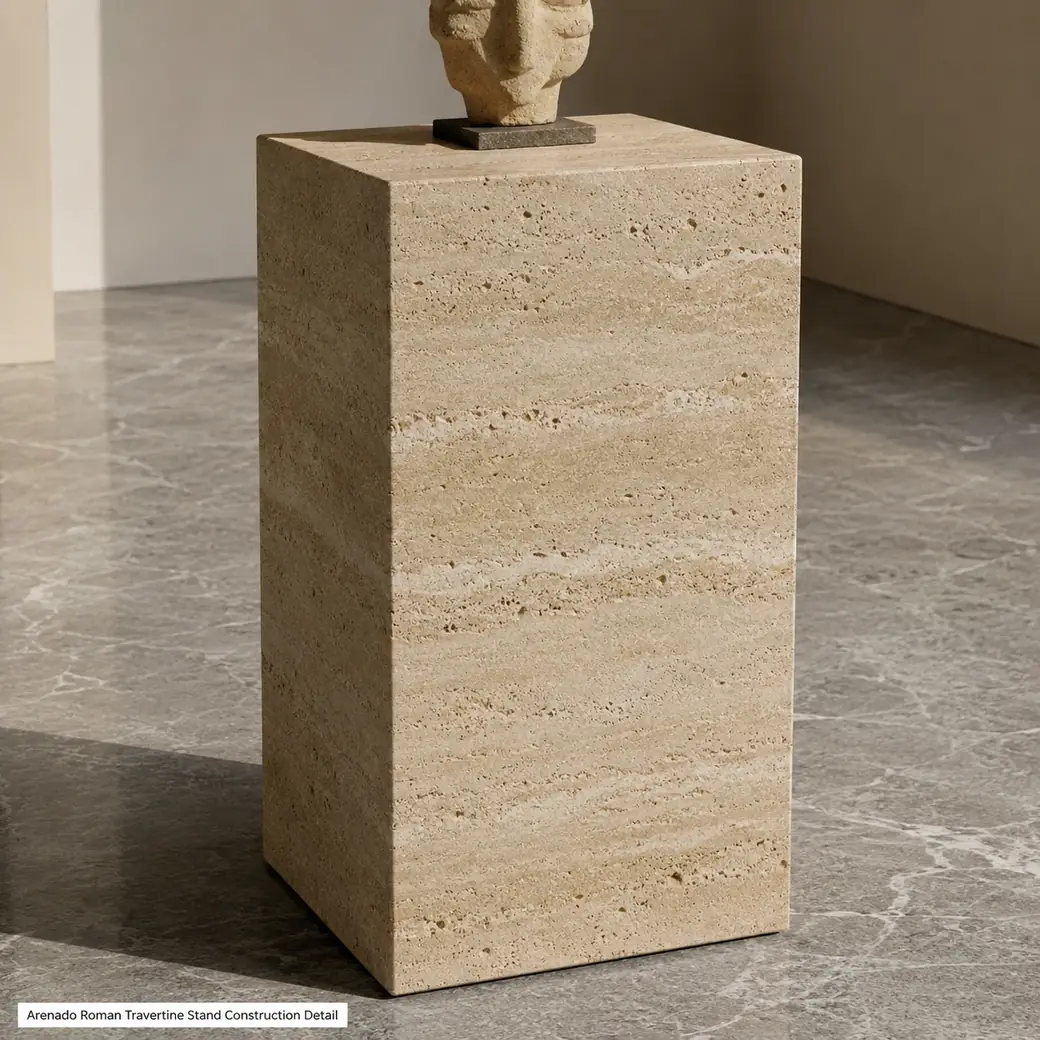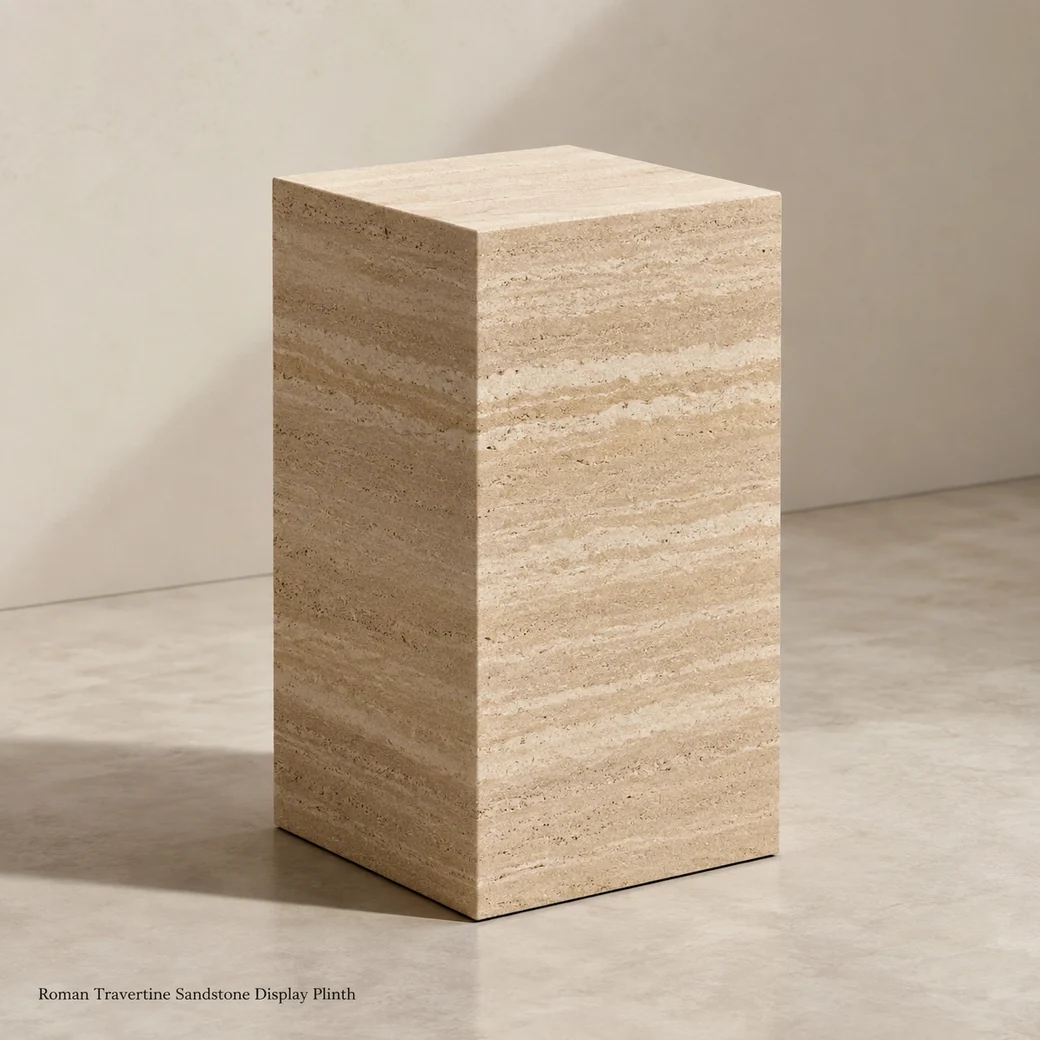
A marble stand can function as a sculpture pedestal, retail plinth, plant stand or display base, with width and height produced around the object being supported. Safe load capacity depends on stone thickness, internal construction, footprint and reinforcement, so the intended display weight should be specified before fabrication. Solid and hollow-built forms are both possible; textured or honed surfaces are especially practical where frequent handling would make fingerprints on a glossy surface distracting.
Sculptural Display Foundations
Marble Stand Small
Secure product inquiry
Buy now
Cash on delivery available. Product details are pre-filled below. Owner delivery adds AED 5,000.
Display Formats & Material Pairings
Build the Right Pedestal for What You Display
The display object should determine the pedestal rather than the pedestal determining the object. A heavy sculpture needs a stable footprint and verified load path, while cosmetics, desserts or retail products may benefit from tiered, paired or glass-covered formats that prioritize visibility over sheer mass.
Surface & Construction
Roman Travertine Display Stand Material and Finish
Roman Travertine used for this display stand is a natural calcareous stone with a sand-beige body crossed by ivory bands that visibly reflect its layered formation. The Arenado Finish introduces a fine textured character rather than a polished sheen, giving the surface a dry, architectural appearance that works particularly well on a pedestal or display plinth. The contrast between sand beige and lighter ivory banding varies naturally through the stone, so the faces of the stand may show different densities and directions of movement. This allows the monolithic form to retain visual depth even without decorative detailing.
Sizing & Placement
Natural Stone Pedestal Stand Size and Use
At 30 × 30 × 50 cm and 24 kg, this travertine pedestal provides a compact but substantial base for sculpture, plants, trays, retail products or decorative objects. The 50 cm height raises an item clearly above floor level without becoming a full plinth, while heavier displays should be matched to the stand's internal construction and support footprint before fabrication.
Stone Display Load Capacity
The 30 × 30 cm footprint and 24 kg stone mass provide a stable display base, but final load capacity must follow the object's weight and stand construction.
Solid and Hollow Plinth Construction
The 30 × 30 × 50 cm stand may be solid or hollow-built, but internal construction must be engineered around the intended display load.
Retail Art and Plant Display
Use the 30 × 30 × 50 cm travertine stand for sculpture, plants or retail display only when the supported object fits securely within its top footprint.
Product Facts
Stone Display Plinth Product Details
This Roman natural-calcareous-stone display plinth measures 30 × 30 × 50 cm, weighs 24 kg and has a sand-beige Arenado finish with ivory bands. Its footprint is 30 × 30 cm, but the construction may be solid or hollow-built; no certified load rating or maximum supported-object size is supplied, so both must be confirmed from the intended display weight and geometry.
| Maximum Distributed Load | 50 kg maximum evenly distributed load |
|---|---|
| Top Footprint Clearance | Maximum object footprint 24 × 24 cm, leaving 30 mm clear margin on all four sides. |
| Center-of-Gravity Limit | Display load must remain centered so the combined centre of gravity stays within the middle 20 × 20 cm of the 30 × 30 cm footprint; off-centre or projecting objects require anchoring. |
| Internal Reinforcement | Concealed 25 × 25 × 2 mm powder-coated steel box frame with welded top and bottom plates, epoxy-bonded inside the hollow stone pedestal. |
| Base Contact Area | Minimum 28 × 28 cm continuous floor-contact area beneath the 30 × 30 cm stand, allowing only a narrow recessed shadow gap around the perimeter. |
| Anti-Tip Provision | Concealed stainless-steel anti-tip bracket at the upper rear, mechanically anchored to the internal reinforcement and secured into a structural wall fixing. |
| Floor Protection | Full-face 3 mm neoprene-felt composite protector beneath the 30 × 30 cm base, recessed approximately 2 mm from the visible perimeter. |
| Object Fixing Provision | Concealed M8 stainless-steel threaded insert centered in the reinforced top plate, allowing the displayed object to be mechanically secured from below. |
| Leveling Adjustment | Four concealed M6 leveling glides beneath the 30 × 30 cm base, providing approximately 8 mm vertical adjustment with non-marking pads. |
| Fabrication Tolerance | Width and depth ±2 mm, height ±3 mm, top-to-base centring within 1.5 mm and verticality deviation no greater than 2 mm over 500 mm. |
Protection & Upkeep
Textured Stone Pedestal Care
Handle the arenado Roman Travertine pedestal from its reinforced base rather than pulling it by an upper edge. Keep the displayed load centered, within the rated limit and securely fixed where its height or projection creates instability; use floor protection beneath the 24 kg stand. The textured surface disguises fingerprints better than polish but should still be dusted and cleaned neutrally, with covered-outdoor use limited to locations protected from standing water and severe weather.
Designed for Use
Why Choose a Travertine Display Pedestal
A Travertine display pedestal gives buyers a dedicated architectural base that visually separates and elevates sculptures, plants or premium retail objects. Its substantial appearance makes the displayed item feel intentional while custom proportions allow the pedestal to match the object rather than compete with it.
- Stable Display Support
The Travertine pedestal provides a weighted support platform whose dimensions and reinforcement can be matched to the displayed object.
- Custom Height Options
Custom pedestal heights allow the Travertine stand to position sculptures, plants or retail objects at the most effective viewing level.
- Solid Hollow Construction
Solid construction provides maximum stone mass, while hollow-built fabrication can reduce weight while maintaining the required pedestal dimensions and appearance.
- Multiple Display Uses
The Travertine stand can function as a sculpture pedestal, retail plinth, plant base or decorative display support depending on its dimensions and construction.
Custom Fabrication
Custom Stone Display Stand Options
Custom Roman Travertine display stands can be made to the required height and width in round, square or bespoke forms, with internal reinforcement determined by the intended display load. Glass covers, brass or steel accents and solid or hollow construction can be specified for retail, gallery or hospitality projects, while stone choice can coordinate with materials such as travertine marble.

Specification Table
Display Stand Technical Specifications
The technical table brings together Roman Travertine natural calcareous stone, Arenado finish, sand-beige colouring with ivory bands, 30 × 30 × 50 cm dimensions and 24 kg weight with rated display load, internal construction, top footprint, centre-of-gravity considerations, floor protection and intended indoor or sheltered placement.
Product details
Specifications, care, delivery and FAQ
Everything is rendered from product JSON fields so the page remains SEO-ready even before JavaScript runs.
Cleaning: Dust the Arenado texture with a soft brush, wipe using a lightly damp cloth and neutral cleaner, clean object-contact areas before replacing displays, dry completely, avoid acidic sprays stiff brushes and soaking porous Travertine
Daily Care: Keep the displayed load centred, dust the textured surface with a soft brush, use a protective pad beneath the object, wipe spills promptly, avoid dragging the stand, check stability and floor protection regularly
- Placing an off-centre object beyond the rated load
- using a footprint too narrow for a tall display
- cleaning textured Travertine with acids
- dragging the stand across flooring
- exposing an indoor-rated stand to uncontrolled weather
Maintenance: Keep the display load centred, use a soft pad beneath sculptures or planters, dust textured Travertine with a soft brush, wipe spills promptly, verify base stability, avoid relocating the loaded stand
Handling: Remove the displayed object before moving the 24 kg Travertine stand, lift from beneath with two hands or two people, keep the pedestal upright, avoid gripping the textured edges, protect the floor with a padded dolly, verify level placement before reloading
How much display weight can a stone stand safely carry based on its top size, wall thickness, internal construction and reinforcement?
A stone stand’s safe capacity cannot be calculated from top dimensions alone: it depends on the stone’s tested strength, vein direction, wall thickness, joints, internal frame, support footprint, load position and resistance to tipping. A 30 × 30 cm hollow Travertine pedestal with thin bonded walls may carry far less than a reinforced unit of identical appearance. Give the fabricator the object’s actual weight, footprint and centre of gravity; for valuable or heavy sculptures, use a concealed steel frame or engineered core and obtain a documented load rating with an appropriate safety factor before display.
Is solid stone or hollow-core reinforced construction safer and more practical for this 50 cm-high Roman Travertine pedestal when it must support a heavy sculpture?
Hollow-core reinforced construction is normally more practical than a fully solid Travertine pedestal because it reduces weight while allowing a concealed steel or engineered internal frame to carry the sculpture safely. A solid pedestal may be stable but is difficult to transport and can still crack around natural voids. For this 30 × 30 × 50 cm stand, specify the sculpture’s weight, footprint and centre of gravity so the fabricator can design the core, top plate and floor restraint and issue a verified load rating.
What pedestal height provides the best eye-level presentation for sculptures, plants or retail products without making this 30 × 30 cm Roman Travertine stand unstable?
A 50–70 cm plinth generally presents small sculptures or products near comfortable viewing height, while taller 80–110 cm pedestals suit compact focal objects in galleries or retail settings. The ideal height equals the desired viewing level minus the displayed object’s visual centre height. This 50 cm Roman Travertine stand suits a medium sculpture rather than a small jewellery item. As height increases, widen or weight the base and verify overturning resistance for the object’s actual mass and centre of gravity.
Can this Arenado-finish Roman Travertine display stand remain outdoors, or is it better restricted to interiors because of moisture, heat, staining and weather exposure?
The stand can be used outdoors only when the specific Travertine, construction, anchors and finish are approved for that exposure. UAE heat is manageable, but irrigation water, salts, dust, rain, thermal cycling and trapped moisture can stain or degrade filled areas. For exterior use, provide drainage, suitable penetrating protection where testing supports it, stainless fixings and a stable foundation; otherwise, an Arenado Travertine pedestal will retain its appearance more predictably indoors or in a sheltered exterior location.
How should the 30 × 30 cm footprint of this Roman Travertine stand be resized for a tall sculpture, heavy planter or wide display object to prevent tipping and concentrated loads?
The footprint should be designed from the display object’s centre of gravity, width, weight and likely contact rather than enlarged by a fixed percentage. A tall sculpture may require a base approaching the object’s width and concealed anchoring, a heavy planter needs full load distribution and moisture isolation, and a wide object requires sufficient bearing area or an internal frame; a fabricator should verify overturning resistance before production.
Reviews
Reviews and new review submission
0.0 average rating from 0 reviews. New reviews are saved as pending until approved.
No approved reviews yet for this product. The review form is ready for buyer submissions.