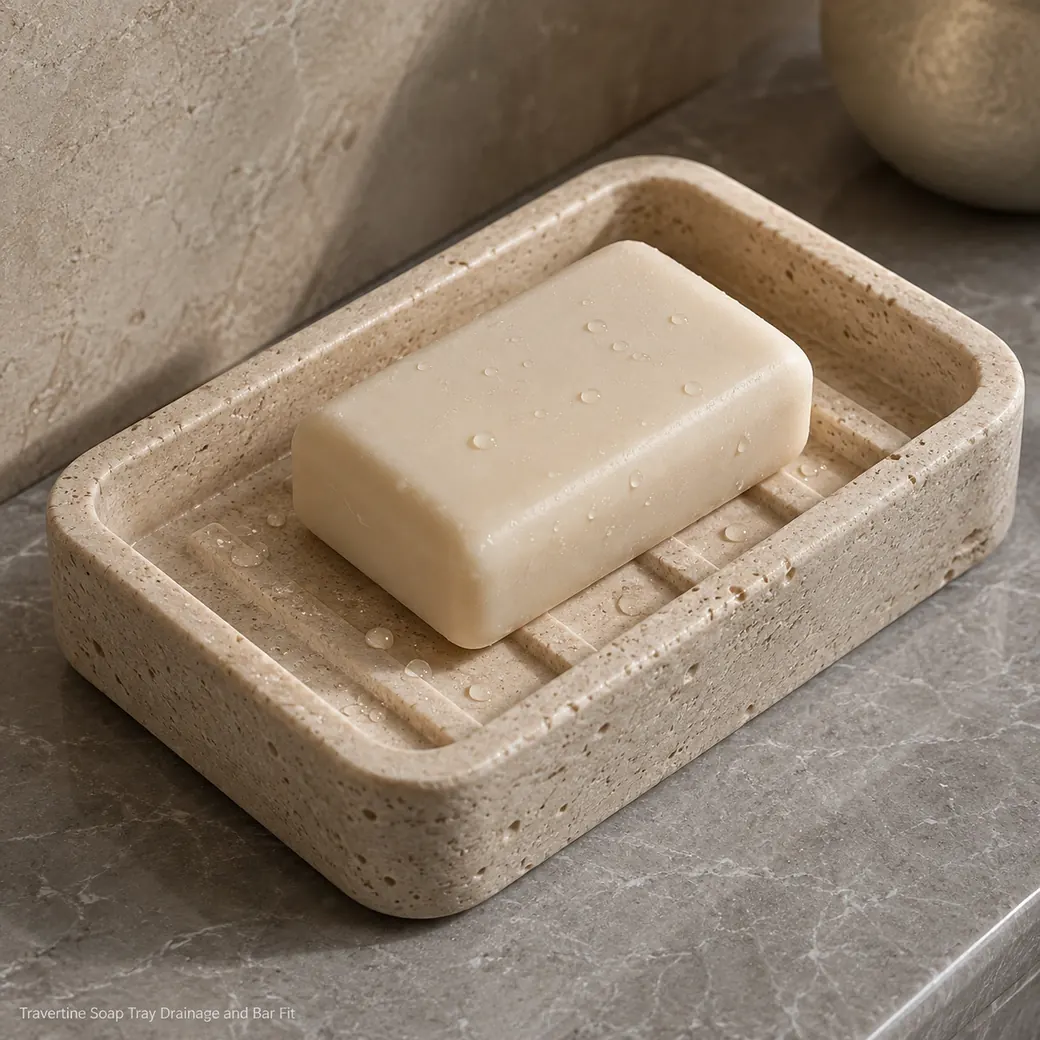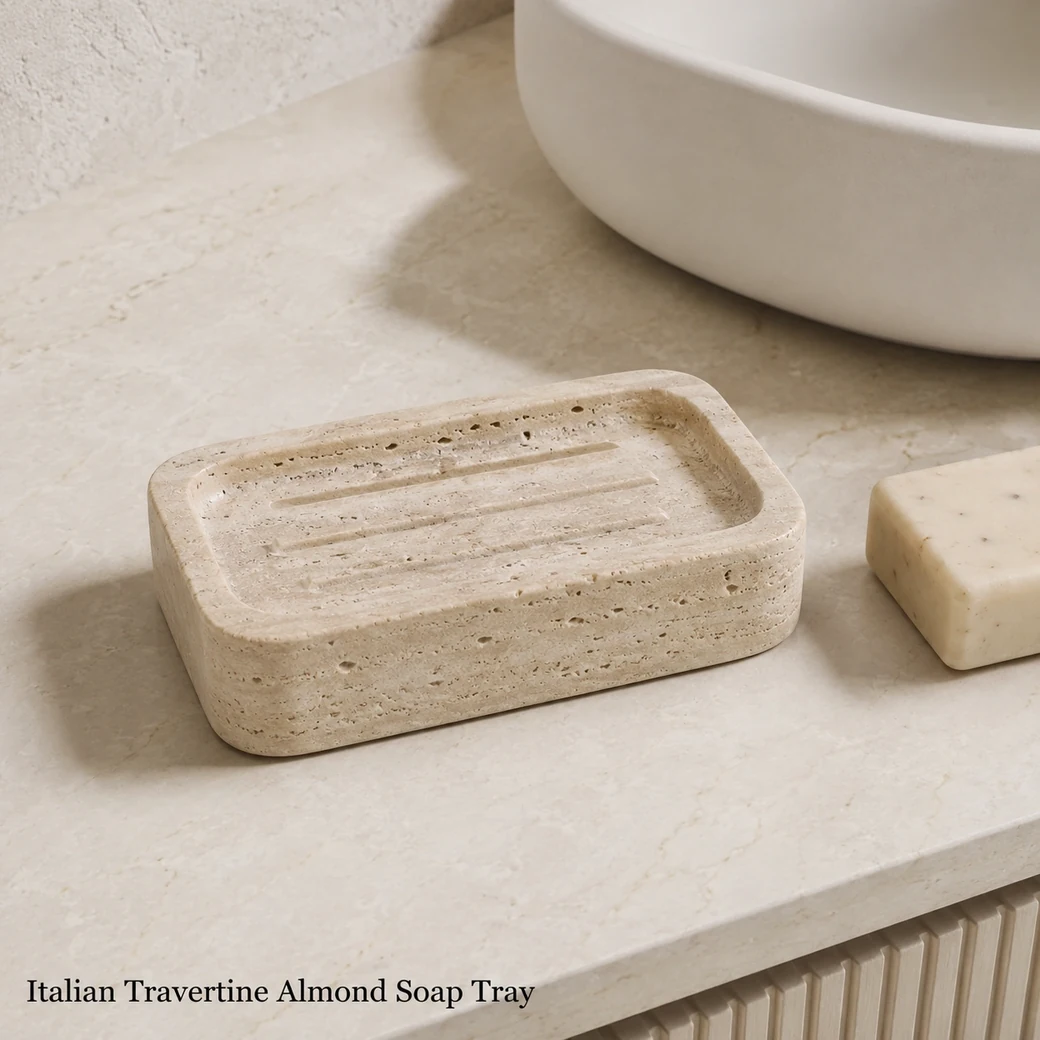
A soap tray for bathroom use is most practical with a shallow channel, raised ribs or slight drainage feature that lets bar soap dry rather than sit in water. A broader version can hold one or two dispenser bottles, while a compact dish should only slightly exceed a standard soap bar. Stone gives good stability, optional feet improve grip, and soap residue should be removed with pH-neutral cleaner instead of acidic bathroom sprays.
Soap Tray Drainage Guide
Marble Soap Tray Small
Secure product inquiry
Buy now
Cash on delivery available. Product details are pre-filled below. Owner delivery adds AED 5,000.
Weighted Sink-Side Caddy
Keep Soap and Dispensers Stable Beside the Sink
Multi-slot stone caddies can organize bar soap and dispenser bottles more effectively than a single shallow dish. Drainage grooves, raised ribs and non-slip pads improve wet-area usability, while the substantial weight keeps taller pump bottles stable when they are pressed repeatedly beside a sink.
Soap Size & Drainage
Choosing a Travertine Soap Tray for a Bathroom Counter
The 12 × 7 cm footprint is suited to a standard bar of soap because it provides a compact resting area without leaving excessive unused stone around the bar. It works best where the soap dimensions remain comfortably within the tray so edges and drainage details can still function effectively. If the bathroom setup includes pump bottles, lotion, toothbrush accessories or more than one soap product, this footprint becomes restrictive; a wider organizer-style tray is then preferable because dispenser bottles require greater base clearance and stability than a single bar of soap.
Keep the Bar Drier
How a Natural Stone Soap Rest Should Drain
A functional stone soap rest should lift the bar above pooled water through ribs, shallow channels or a gently raised centre. Those features direct water toward open edges or drainage points, allowing air to reach more of the soap surface and reducing the soft residue that develops when a wet bar sits flat against stone.
Raised Ribs in a Marble Soap Holder Tray
Use raised ribs or shallow channels so the soap rests above residual water rather than lying flat against a continuously wet surface.
Travertine Soap Dispenser Tray Options
A wider custom version can accommodate one or two pump bottles, but the width should still leave usable counter space around the sink.
Non-Slip Feet for a Stone Soap Caddy
Non-slip or cushioned feet help the 0.7 kg tray stay stable on a wet counter while isolating the stone from scratching the surface below.
Product at a Glance
Travertine Soap Tray Product Details
This soap tray is fabricated from Beige Travertine in a soft almond-beige colour with a Filled Satin finish. The 12 × 7 × 3.5 cm format weighs 0.7 kg, giving it a compact footprint for a standard soap bar while retaining enough stone mass for stable bathroom-counter use.
| Usable Soap Bed | ≈10 × 5 cm usable soap bed |
|---|---|
| Recess Depth | ≈6 mm recessed soap-bed depth. |
| Drainage Channel Count | Three drainage channels, each approximately 5 mm wide × 3 mm deep, running beneath the soap toward the open drainage edge. |
| Channel Depth | Three drainage channels, each approximately 4 mm deep with rounded bottoms to simplify cleaning and reduce standing water. |
| Edge Radius | R4 rounded upper perimeter with R2 underside easing, reducing chipping and improving comfortable handling around the 12 × 7 cm tray. |
| Anti-Slip Feet | Four Ø10 × 3 mm food-grade silicone feet arranged around the base, providing slip resistance and drainage clearance on wet countertops. |
| Base Contact Area | Approximately 9 × 4.5 cm stable base-contact area beneath the 12 × 7 cm tray, supported by four non-marking silicone feet. |
| Bottle Compatibility | Suitable for pump or dispenser bottles with footprints up to approximately Ø55 mm, or one compact bottle and a soap bar within the 12 × 7 cm surface. |
| Overflow Path | Open 25 mm-wide overflow path at the lower short edge, aligned with the drainage channels so water escapes away from the bottle footprint. |
| Countertop Protection | Four non-marking silicone pads and a removable 1 mm waterproof base liner protecting the countertop from stone contact, soap residue and retained moisture. |
Sink, Shower or Kitchen
Where to Use a Marble Soap Organizer
Place the 12 × 7 cm Calacatta Viola soap organizer beside a bathroom basin for a compact bar or dispenser, on a properly supported shower shelf where drainage remains open, or near the kitchen sink for hand soap. Keep it out of direct spray where possible and leave enough surrounding space to lift the soap or bottle without striking the stone rim.
Designed for Daily Soap
Why Choose a Travertine Soap Caddy
A Travertine soap caddy gives buyers a stable place for a bar of soap or small dispenser while raised ribs, channels or drainage details help keep the soap from sitting in pooled water. Compact sizing reduces wasted vanity space, and optional feet can improve grip while protecting the surrounding counter.
- Compact Bar Soap Fit
The compact 12 × 7 cm Travertine dish closely fits a standard soap bar, reducing unused vanity space while keeping it contained.
- Raised Drainage Surface
Raised ribs or a shallow drainage profile keeps the soap above residual water, helping the bar dry instead of sitting continuously in moisture.
- Weighted Counter Stability
The 0.7 kg Travertine build helps the compact soap tray remain securely positioned on the counter as the bar is repeatedly lifted and replaced.
- Custom Bottle Sizing
The Travertine tray can be fabricated wider or with tailored recesses to fit one or two dispenser bottles instead of only a standard soap bar.
Residue & Stone Care
Cleaning a Satin Travertine Soap Rest
Soap film on a satin Travertine rest should be removed regularly with warm water and a soft cloth or sponge before residue builds up in the drainage areas. Use only a pH-neutral stone cleaner, rinse away remaining product and dry the tray thoroughly rather than leaving it continuously wet; the same care information is relevant when dealing with a marble exporter with container load supplying natural-stone bathroom accessories.

Technical Overview
Marble Soap Tray Specifications
Use the specification table to verify the 12 × 7 × 3.5 cm dimensions and 0.7 kg weight together with Italian Classico Beige Travertine, filled satin finish, soft almond-beige appearance, drainage-channel or raised-rib profile, protective feet and compatibility with standard soap bars or dispenser bottles.
Product details
Specifications, care, delivery and FAQ
Everything is rendered from product JSON fields so the page remains SEO-ready even before JavaScript runs.
Cleaning: Rinse soap film weekly, soften buildup with warm water and pH-neutral cleaner, use a soft nylon brush, rinse sparingly, dry the satin surface and drainage channels, avoid vinegar acidic descalers abrasive powders and metal scrapers
Daily Care: Rinse soap film weekly, keep drainage channels open, dry pooled water, use pH-neutral cleaner, avoid acidic descalers and abrasive tools, inspect filler for loosening or discolouration
- Allowing constant pooled water
- using acidic descaler
- scraping the satin finish with metal tools
- ignoring loose or discoloured filler
- placing oversized dispenser bottles on the compact dish
Maintenance: Rinse film weekly, keep ribs or channels clear, dry standing water, use pH-neutral cleaner and a soft brush, inspect filler for loosening, improve airflow with discreet silicone feet
Handling: Clear the soap and pooled water before lifting, support the 0.7 kg Travertine dish from below, avoid dropping it into the basin, use widely spaced silicone feet, never scrape soap from the satin finish with metal tools
Do raised ribs or drainage channels dry a wet soap bar faster and prevent more residue buildup on a Travertine soap tray?
Raised ribs usually dry soap faster by reducing contact with the tray and permitting airflow, while drainage channels remove water only when they have a continuous slope toward an outlet. The most effective Travertine design combines both: three or four rounded ribs, shallow cleanable channels and a slight overall fall. Avoid narrow grooves that trap softened soap. A filled surface and appropriate penetrating protection can reduce residue absorption, but the tray still needs regular rinsing, pH-neutral cleaning and complete drying.
Is this 12 × 7 cm Travertine tray suitable only for one soap bar, or should a wider custom version be used for dispenser bottles and additional bathroom accessories?
The 12 × 7 cm Travertine tray is suitable for one standard soap bar if those are usable internal dimensions and drainage is included. It is too narrow for most dispenser bottles, which generally need a platform around 12–15 cm wide for one bottle or 20–30 cm for a coordinated pair. Do not crowd a dispenser onto the soap dish because its base may overhang or tip. Order a separate broader tray with raised edges and protective feet for liquid-soap accessories.
Are silicone, rubber, cork or matching stone feet most suitable beneath this Travertine soap tray for wet-countertop grip, moisture resistance and furniture protection?
Silicone or EPDM rubber feet are best for a wet countertop because they provide grip, resist water and do not absorb soap. Cork can swell or stain when repeatedly wet, while matching stone feet can scratch the counter and provide limited traction. Use small clear non-staining pads with compatible adhesive, raised enough for airflow but not so high that the narrow 12 × 7 cm tray becomes unstable.
Does filled Travertine perform better than unfilled stone around frequent bathroom moisture, and can filler loosen or discolor after repeated exposure to soap and water?
Filled Travertine is more practical because closed pores collect less soap residue and are easier to wipe than unfilled cavities. Quality filler should tolerate normal moisture, but poor or incompatible resin can discolor, crack or detach after repeated saturation, harsh cleaners and movement. Use a bathroom-suitable filler, provide drainage and avoid standing water. Inspect filled pores periodically and have damaged areas professionally replaced rather than covering them with sealer.
How frequently should soap film be removed from this satin-finished Travertine dish to prevent buildup without overcleaning or wearing its filler and finish?
Remove visible soap film weekly in normal use, or sooner if water is hard or the dish remains wet, using a soft cloth and pH-neutral stone cleaner. Frequent gentle wiping is safer than allowing thick deposits to develop and then scrubbing aggressively; rinse sparingly, dry the tray and avoid acidic descalers that can attack the filler and satin finish.
Reviews
Reviews and new review submission
0.0 average rating from 0 reviews. New reviews are saved as pending until approved.
No approved reviews yet for this product. The review form is ready for buyer submissions.