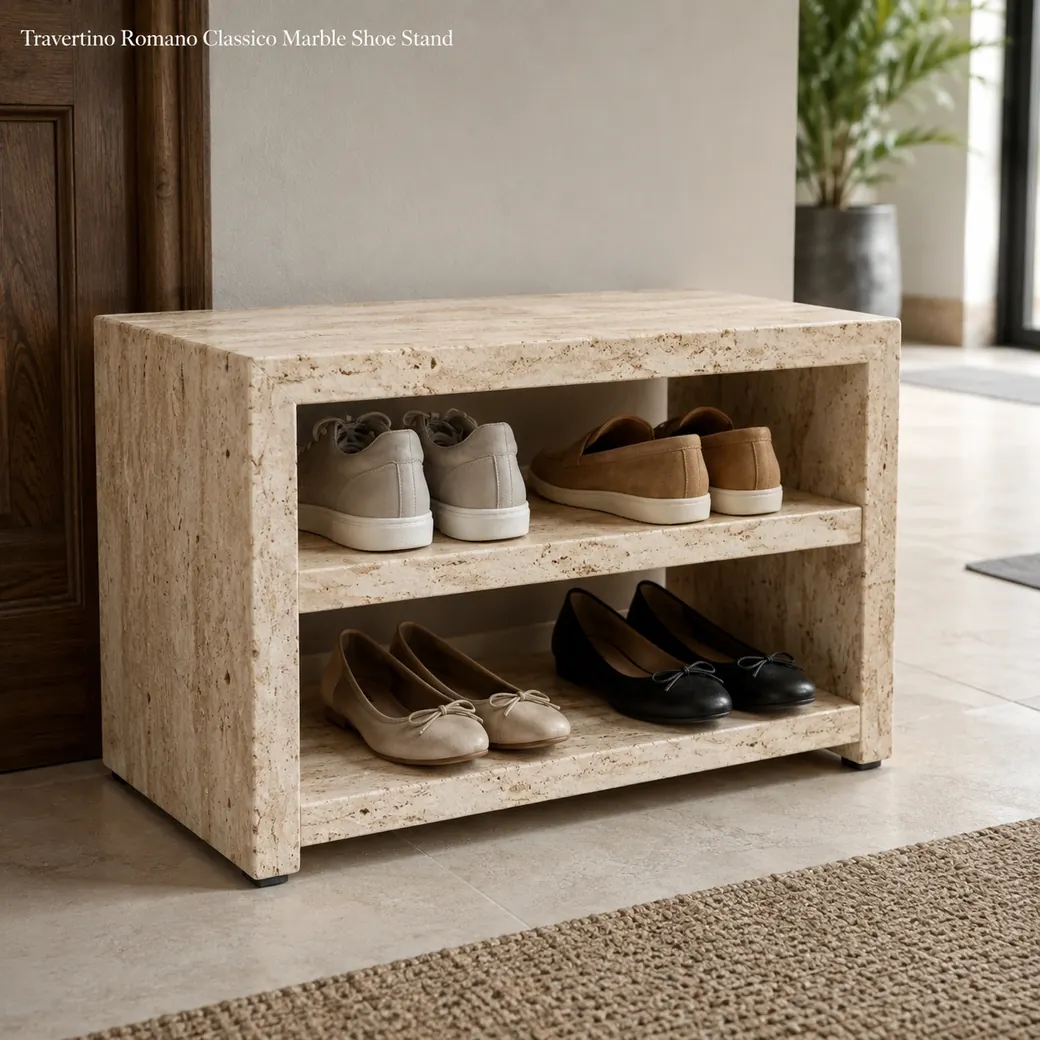
A shoe stand can be configured with one, two or several tiers depending on available entryway space and the number of pairs stored. Stone is practical as a stable base, but wet footwear should not leave standing water on the surface; brushed or textured areas also collect grit and need regular cleaning. Entryway use is appropriate when floor pads, drainage and shelf spacing are planned for the footwear type.
Refined Entryway Shoe Storage
Marble Shoe Stand Small
Secure product inquiry
Buy now
Cash on delivery available. Product details are pre-filled below. Owner delivery adds AED 5,000.
Tiered Entryway Organization
Choosing Tier Count, Capacity and Entryway Fit
The appropriate tier count depends on how many pairs need daily access and whether shoes require airflow after use. Two- to five-tier racks are common, with open shelves helping damp footwear dry more readily than closed cabinets. For an entryway, a raised lower shelf, non-slip feet and easy-clean surfaces are particularly useful because water and mud are more likely to reach the stand there than in a wardrobe.
Storage Capacity
Choosing the Right Marble Shoe Rack
Choose a shoe rack by the number of pairs and the largest footwear that will use it, not merely its overall width. Low shoes and sandals can use tighter vertical spacing, while boots and high-top footwear need greater clearance; additional tiers increase pair capacity but should still allow each pair to be removed without disturbing the shelf above.
Entryway Formats
Travertine Shoe Shelf Configurations
A raised single platform suits a few frequently worn pairs and keeps cleaning simple underneath. Two-tier racks double capacity without excessive height, while multi-tier metal-frame systems are better for larger collections because the frame carries the vertical structure and the travertine can remain concentrated at shelves or the stable base.
Entryway Shoe Stand Pair Capacity
The 60 × 30 × 40 cm body should be divided around realistic shoe length and pair width so footwear fits without toes, heels or upper tiers interfering.
Stone Footwear Rack Water and Mud Handling
Use drip trays or drainage beneath wet footwear and dry the brushed travertine promptly so water and grit do not remain trapped on the shelves.
Luxury Shoe Organizer Base Protection
Fit non-slip, non-marking pads beneath the 32 kg travertine stand so its concentrated weight does not scratch floors or allow the unit to creep during use.
Product Data
Light Beige Shoe Storage Details
This small Light Beige Shoe Storage stand uses Travertino Romano Classico in a Natural Travertine grade, displaying Light Cream Beige stone with Brown Veining under a Brushed Finish. Measuring 60 cm × 30 cm × 40 cm and weighing 32 kg, its substantial low-profile construction provides stable entryway storage for everyday footwear.
| Usable Shelf Width | Approx. 55 cm usable shelf width |
|---|---|
| Shelf Depth | Approx. 28 cm usable shelf depth |
| Shelf Clear Height | 180 mm clear shelf height for low shoes and trainers |
| Heel Stop Lip | 20 mm-high rear heel-stop lip with R3 mm rounded edge |
| Toe Clearance | 260 mm clear toe depth from front edge to rear stop |
| Shelf Load Rating | 20 kg uniformly distributed load rating per shelf |
| Frame Joint Type | Fully welded mitred SUS304 frame joints ground smooth before finishing |
| Base Footprint Stability | Base depth equal to at least 60% of the stand height for freestanding stability |
| Boot Clearance | 400 mm clear shelf height in the lower bay for ankle and mid-calf boots |
| Shelf Edge Radius | R5 mm radius on all exposed shelf edges |
Made to Order
Custom Foyer Shoe Rack Options
A custom foyer shoe rack can be configured with more tiers, greater boot clearance and a width matched to the entrance wall. Frame material, shelf spacing and stone selection should be finalized together so the completed rack supports the required footwear load without becoming visually or physically unstable.
Key Benefits
Why Choose This Stone Shoe Stand
A stone shoe stand gives entryways defined storage capacity based on shelf width and tier count rather than leaving footwear scattered across the floor. Open spacing between shelves helps air circulate around shoes after use, while the Travertine base provides substantial stability. Buyers can configure capacity around everyday footwear, boots or guest use to keep the foyer organized without unnecessary bulk.
- Multi Pair Storage
Multi-tier construction keeps several pairs organized vertically, increasing footwear capacity without spreading shoes across the foyer floor.
- 32 kg Stability
The 32 kg Travertine structure gives multiple pairs of footwear a substantial entryway storage base that remains firmly positioned during daily use.
- Open Air Drying
Open shelf spacing allows air to circulate around footwear, helping damp shoes dry instead of being enclosed immediately after use.
- Custom Tier Layout
Tier quantity, shelf spacing and overall height can be configured around sandals, shoes or taller footwear and the available entryway space.
Purchase Guidance
Before Ordering a Travertine Shoe Organizer
Before ordering a Travertine shoe organizer, confirm how many pairs it must hold and the tallest boot or shoe height so shelf spacing is genuinely usable. State whether wet footwear will be stored, because drainage and drying become more important, and identify the floor type so suitable pads can protect timber, tile or other finishes; comparing natural materials such as white travertine also helps when coordinating surrounding entryway stone.

Specification Reference
Marble Shoe Stand Technical Specifications
The technical table should confirm the 60 × 30 × 40 cm dimensions and 32 kg weight together with tier count, practical pair capacity, shelf clearances and protective floor pads or drainage details so you can select the configuration around everyday shoes, taller boots and damp-footwear conditions.
Product details
Specifications, care, delivery and FAQ
Everything is rendered from product JSON fields so the page remains SEO-ready even before JavaScript runs.
Cleaning: Remove footwear and dry-brush grit from the brushed travertine following its texture, wipe wet-footwear residue using pH-neutral stone cleaner and a soft nylon brush, clear drainage points and dry shelves promptly, clean floor pads regularly, avoid acids bleach abrasives pressure washing and standing water
Daily Care: Brush grit from the textured travertine daily, wipe water from wet footwear immediately, keep drainage paths and shelf contacts clear, clean with pH-neutral stone cleaner and a soft brush, avoid acids abrasives and standing water
- Avoid leaving wet footwear and standing water on brushed travertine
- avoid allowing grit to accumulate in the texture
- avoid exceeding shelf capacity
- avoid blocking drainage
- avoid acidic or abrasive cleaning products
Maintenance: Brush grit from the textured travertine regularly, wipe wet-footwear residue immediately, keep drainage and dry contact points clear, clean with pH-neutral stone cleaner and a soft brush, inspect shelf supports and floor pads, distribute footwear evenly, renew appropriate protection only when professionally recommended
Handling: Empty all tiers before handling the 32 kg stand, use two people and lift from engineered supports, keep the unit upright and level, protect floors with load-spreading pads, distribute shoes evenly during use, never drag the stand or lift it by a shelf
Is a one-tier or multi-tier marble shoe stand more practical based on the number of pairs, footwear height and available entryway space?
A one-tier stand suits two or three everyday pairs in a narrow entrance, while a multi-tier model is more efficient for larger households if vertical clearance is planned correctly. Allow about 18–22 cm per level for low shoes and 30–45 cm for boots or high-tops, and keep frequently used footwear on the easiest-to-reach tier.
What clear shelf height is needed to accommodate sneakers, high heels and ankle boots without compressing the footwear or wasting vertical space?
Allow about 18–22 cm of clear height for sneakers, 20–25 cm for most high heels and 35–45 cm for ankle or short boots. Adjustable or mixed-height shelves are more efficient than identical tiers, and additional lifting clearance is needed where shoes must be inserted beneath a projecting shelf.
How many pairs of adult shoes can a 60 cm shelf hold comfortably after allowing for wide sneakers, high heels and enough separation to remove each pair?
A 60 cm shelf will normally hold two pairs of adult shoes comfortably. Three pairs may fit only if they are narrow, while wide sneakers or heels need approximately 25–30 cm per pair plus small gaps for easy removal.
Which non-staining, load-spreading floor pads should be fitted beneath this 32 kg travertine shoe stand to prevent scratches, moisture marks and concentrated pressure?
Fit broad, colourfast EPDM or silicone pads beneath every structural bearing point, ideally at least 40–50 mm wide rather than small bumpers that concentrate the 32 kg load. Dense full-surface felt can protect dry timber but absorbs moisture from wet shoes, while cork may compress; non-staining elastomer pads with verified plasticizer compatibility provide the best grip, moisture resistance and load distribution.
What drainage tray, raised shelf and cleaning access should this brushed travertine shoe stand include to manage water, grit and dirt from wet entryway footwear?
Use a removable waterproof drip tray beneath a raised slotted or perforated shelf so shoes remain above collected water. Provide front access for tray removal, open airflow around footwear and smooth brush-accessible corners; remove grit before wiping the travertine and never allow dirty water to dry inside its brushed texture.
Reviews
Reviews and new review submission
0.0 average rating from 0 reviews. New reviews are saved as pending until approved.
No approved reviews yet for this product. The review form is ready for buyer submissions.