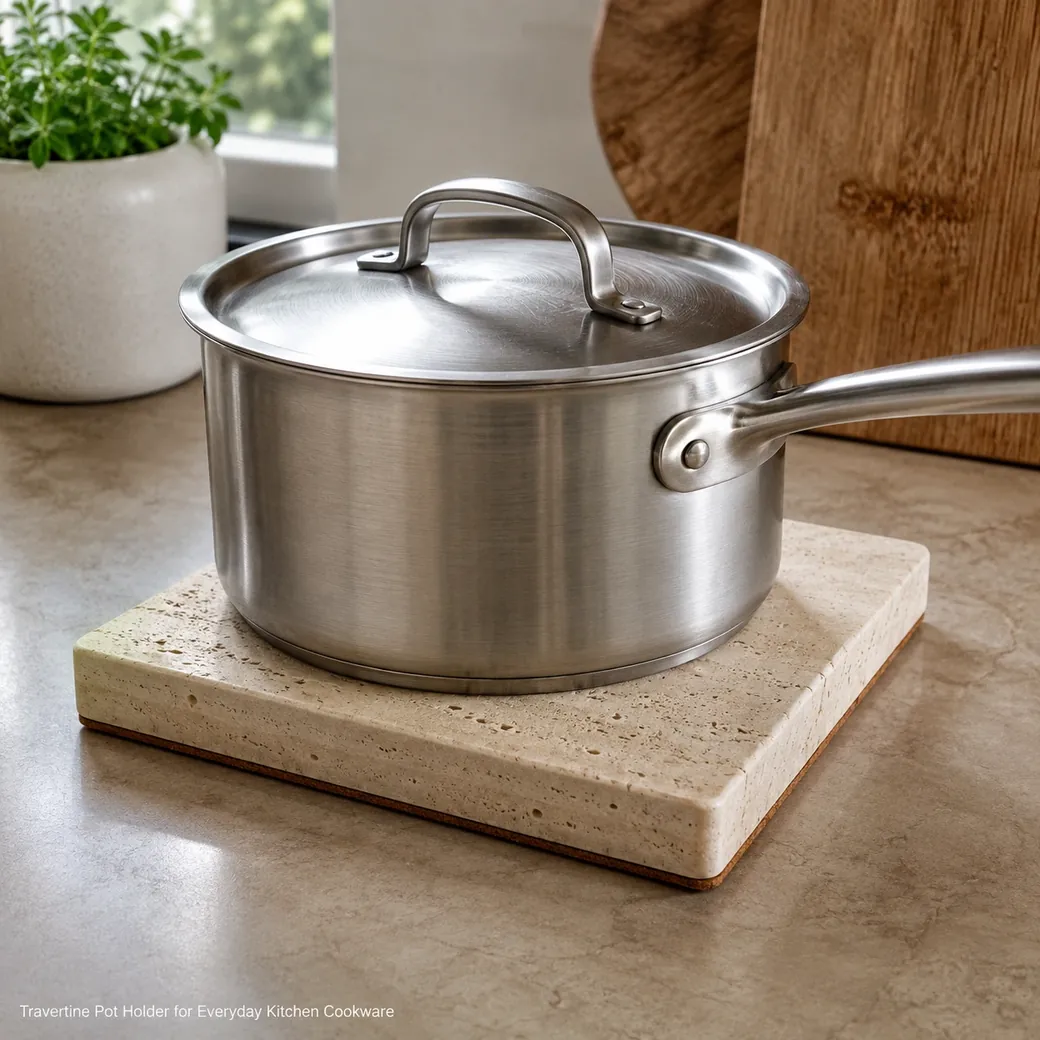
A pot holder or trivet can use stone as a firm barrier beneath cookware, but a very hot pan should not be placed directly on a decorative natural-stone surface when a purpose-made heat mat can provide safer thermal protection. Size the trivet to support the cookware base completely and add felt or cork beneath it to protect the table from scratching. Clean food residue with neutral stone cleaner rather than vinegar or lemon-based products.
Heat Protection for Cookware
Marble Pot Holder Small
Secure product inquiry
Buy now
Cash on delivery available. Product details are pre-filled below. Owner delivery adds AED 5,000.
Stone Trivet Crossover
Choosing a Stone Trivet Format
The 20 × 20 cm size is roughly an 8-inch square, placing it within the common 7–10 inch trivet range for hot cookware. For actual tabletop protection, the stone surface should be paired with a cork, felt or other non-slip backing so the trivet protects against both transferred heat and scratches from the stone itself.
Buyer Fit
Choosing the Right Marble Trivet
A 20 × 20 cm Classic Beige Travertine pot holder is best understood as a solid stone trivet for supporting cookware rather than a textile potholder used for gripping hot handles. Its firm 2 cm-thick stone surface creates a stable barrier beneath pans, serving dishes or cookware bases, provided the vessel sits fully within the trivet footprint. Because natural travertine is decorative stone rather than a purpose-made high-temperature pad, extremely hot cookware is better paired with additional thermal protection instead of being placed directly onto the Filled & Brushed surface. Unlike fabric potholders, this piece is intended to remain on the table or countertop rather than be wrapped around cookware for lifting.
Format Options
Marble Hot Pad Formats for Daily Use
Round stone trivets suit circular pans and serving pots, while square formats give more usable area beneath rectangular dishes or cookware with wider bases. Cork, felt or non-slip backing protects the table from the stone underside, improves grip and adds a thermal break between the trivet and the furniture beneath it.
Marble Pot Stand Size and Compatibility
The 20 × 20 cm stone surface should fully support the cookware base rather than leaving hot or heavy edges projecting beyond the trivet.
Marble Pan Holder Stability and Support
The 1.9 kg travertine trivet stays planted beneath cookware, while cork, felt or heat-appropriate backing helps protect the table from scratches.
Marble Heat Resistant Mat Finish and Material Behaviour
Filled-brushed travertine provides a firm cookware base, but very high heat still calls for thermal caution and all residue should be removed with stone-safe cleaner.
Product Data
Stone Trivet Product Details
This small Stone Trivet is crafted from Classic Beige Travertine in a Cream Travertine grade, showing a Warm Cream Beige tone through a Filled & Brushed Finish. At 20 cm × 20 cm × 2 cm and 1.9 kg, it provides a compact, weighty stone platform sized to support cookware while keeping the trivet easy to position on a dining or kitchen surface.
| Usable Cookware Area | 18 × 18 cm |
|---|---|
| Maximum Pan Base Diameter | Ø180 mm maximum fully supported pan-base diameter. |
| Heat Isolation Layer | 3 mm heat-resistant cork isolation layer beneath the marble |
| Underside Protection | Full-coverage 3 mm cork underside pad protecting countertops from scratches and heat transfer |
| Anti-Slip Feet | Four Ø15 × 3 mm non-marking silicone anti-slip feet |
| Thermal Shock Guidance | Place only cookware cooled below approximately 100°C on the marble; avoid direct transfer from flame or oven to reduce thermal-shock risk |
| Load Rating | Maximum evenly distributed cookware load: 20 kg |
| Edge Radius | 5 mm rounded edge radius |
| Tabletop Contact Area | Approximately 361 cm² tabletop contact area across a 19 × 19 cm protected underside |
| Storage Stackability | Stackable with identical units using a protective felt separator; recommended maximum stack height is four pieces |
Made to Order
Custom Marble Table Protector Options
A custom marble table protector can be produced as a square, circle, oval or freeform piece sized to support the full cookware base. Cork provides broad scratch protection, felt suits dry decorative use and silicone improves grip and moisture resistance; Carrara, travertine, granite or darker marbles can be selected, but a separate heat-rated mat should still be used beneath extremely hot cookware.
Key Benefits
Why Choose This Marble Pot Holder Set
This marble pot holder set gives cookware a firm, weighted resting point while helping separate hot or heavy pans from the dining or work surface beneath. Properly sized pieces support the cookware base evenly, while felt or cork backing can further reduce scratching and surface contact during everyday use.
- Small Space Format
The 20 × 20 cm Travertine trivet protects cookware contact points without taking excessive dining or countertop space.
- 1.9 kg Weighted Build
The 1.9 kg Travertine build gives the trivet enough mass to stay firmly positioned beneath cookware during everyday table or countertop use.
- Filled Brushed Surface
The filled-brushed Travertine surface reduces open pores while retaining tactile texture, making the trivet easier to handle and wipe after cookware use.
- Custom Fabrication Options
Diameter, thickness, edge profile and protective backing can be customized around the cookware size and table surface the Travertine trivet will serve.
Purchase Guidance
Before Ordering a Marble Kitchen Trivet
Before ordering a Travertine kitchen trivet, confirm the cookware base diameter so the 20 × 20 cm surface supports the pan without unstable overhang, and specify whether felt, cork or another protective backing is required beneath the stone. Expected heat exposure and the tabletop material should also be considered because very hot cookware is better paired with a purpose-made heat barrier; the same attention to surrounding surfaces matters when specifying furniture such as a reception desk ikea installation.

Specification Reference
Marble Pot Holder Technical Specifications
Use the specification table to confirm the 20 × 20 × 2 cm dimensions and 1.9 kg weight together with Classic Beige Travertine construction, felt or cork backing options and the recommended use as a stable cookware trivet with additional heat protection for very hot pans.
Product details
Specifications, care, delivery and FAQ
Everything is rendered from product JSON fields so the page remains SEO-ready even before JavaScript runs.
Cleaning: Allow the travertine trivet to cool fully, lift away crumbs and grease with a soft cloth and pH-neutral stone cleaner, blot food spills instead of scrubbing them, clean and dry the felt or cork backing separately, avoid vinegar lemon degreasers abrasives soaking and sudden temperature changes
Daily Care: Use a separate high-temperature mat beneath very hot cookware, wipe grease immediately, ensure the complete pan base is supported, clean with pH-neutral products, dry thoroughly, maintain cork or felt protection underneath
- Placing extremely hot cast iron directly on decorative Travertine
- using a trivet smaller than the cookware base
- allowing grease to penetrate
- cleaning with lemon or vinegar degreaser
- using damaged felt or cork backing
Maintenance: Add a purpose-made heat mat above the Travertine, support the complete cookware base, blot grease immediately, use a poultice for absorbed oil, maintain cork or felt underneath, allow cookware to cool before moving it
Handling: Let cookware and travertine cool before handling, support the 1.9 kg trivet with both hands, centre cookware fully within its 20 cm footprint, use a heat mat between very hot pans and stone, fit cork or felt beneath the base, lift rather than drag it across the table
What maximum cookware temperature can a natural-stone trivet safely handle before there is a risk of thermal shock, discoloration or damage to the Travertine surface?
There is no universal safe maximum temperature for decorative travertine because hidden moisture, fillers, thickness and temperature change all affect thermal-shock risk; as a conservative rule, do not place cookware directly from an oven or flame onto the stone, and keep routine contact below approximately 100°C with a 3–5 mm heat-resistant cork or silicone isolation layer, allowing the pan to cool further whenever possible.
How much larger should this marble pot holder be than the base of the pan to provide stable heat protection?
The 20 × 20 cm marble pot holder should be at least as large as the pan’s contact base and ideally extend 1–2 cm beyond it on every side. It is therefore best suited to cookware with a base up to approximately 16–18 cm, provided heat-resistant feet or insulation protect the surface underneath.
Is cork or felt backing more suitable for preventing this 1.9 kg marble pot holder from scratching and transferring heat to a dining table?
Cork is generally better for a 1.9 kg pot holder because it cushions the Travertine, grips furniture and slows heat transfer. Felt protects against scratches but offers less moisture and heat resistance and may compress unevenly. Use a continuous sealed-cork backing or several broad high-temperature cork pads bonded with non-staining adhesive. For very hot cookware, add a certified heat-resistant silicone layer or separate trivet because neither decorative stone nor ordinary cork guarantees unlimited heat protection.
Can hot cast-iron cookware be placed directly on this 2 cm-thick travertine pot holder, or is a separate heat-resistant mat required to prevent thermal shock and surface damage?
Do not place extremely hot cast-iron cookware directly on decorative Travertine. Cast iron stores substantial heat and can create thermal shock, discolor filler or transfer damaging heat through the 20 mm stone to the table. Use a purpose-made high-temperature silicone, cork-composite or metal trivet between the pan and Travertine, with heat-resistant backing beneath the stone. Ensure the complete cookware base is supported and never move the holder suddenly between cold and very hot conditions.
How should cooking grease be lifted from this filled-and-brushed Travertine pot holder without driving oil into the stone or using acidic degreasers?
Blot fresh grease with absorbent paper without rubbing, then clean with warm water and pH-neutral stone cleaner using a soft cloth. For absorbed oil, apply a stone-specific poultice that draws grease outward, following a patch test and manufacturer instructions; avoid acidic kitchen degreasers, solvents and abrasive brushes that can damage the filled, brushed finish.
Reviews
Reviews and new review submission
0.0 average rating from 0 reviews. New reviews are saved as pending until approved.
No approved reviews yet for this product. The review form is ready for buyer submissions.