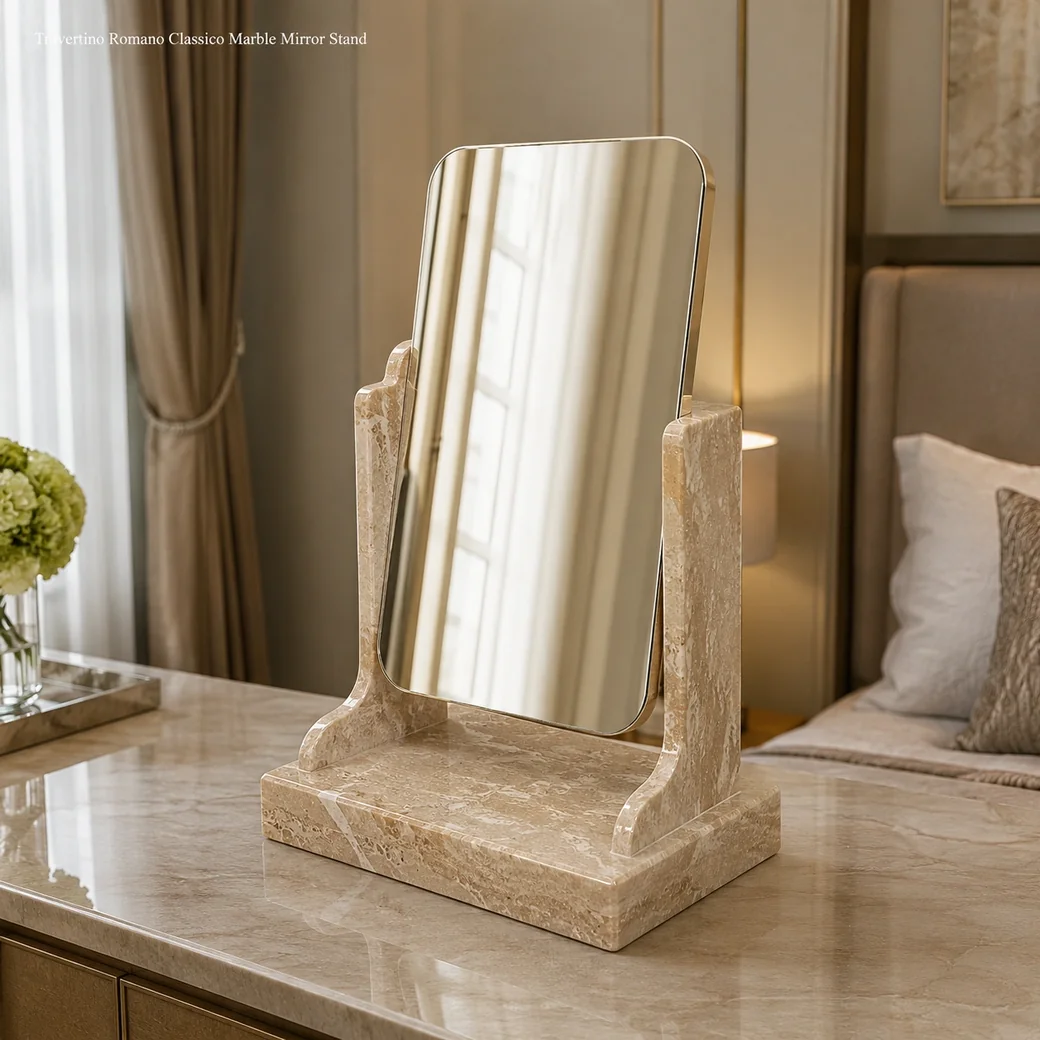
A mirror stand can support a floor or vanity mirror when its base, upright frame and fixing system are engineered for the mirror’s weight and centre of gravity. Heavier or taller mirrors require wider, more stable bases, while leaning mirrors still need anti-tip restraint. Custom sizes and double-sided formats are possible; clean the stone separately from the glass using a soft cloth and non-acidic stone cleaner.
Stable Decorative Mirror Support
Marble Mirror Stand Small
Secure product inquiry
Buy now
Cash on delivery available. Product details are pre-filled below. Owner delivery adds AED 5,000.
Floor, Vanity & Double-Sided Options
Base Weight, Mirror Size and Anti-Tip Support
Mirror stability depends on the relationship between mirror height, base weight and support angle. Slotted stone bases can hold a leaning mirror without a large frame, while brass or steel frames are used for tabletop, double-sided and full-length formats. For a taller mirror, the support groove and anti-tip design become more important than the visual mass of the base alone, especially in hotel or dressing-room environments with frequent use.
Mirror Fit
Choosing the Right Marble Mirror Base
Choose the marble base from the mirror’s full weight, width and center of gravity, because a tall or wide mirror can create substantial overturning leverage even when the glass itself is not exceptionally heavy. Floor-standing mirrors require a broader, more stable base, while smaller vanity mirrors can use a compact support when their center of mass remains well inside the footprint.
Support Formats
Travertine Standing Mirror Configurations
A slotted travertine base creates the simplest stone-led design by holding the mirror directly in a machined channel. Steel or brass frames provide a slimmer structural perimeter and can support larger glass panels, while double-sided formats are more useful for dressing tables where two viewing surfaces or different magnifications are required.
Floor Mirror Stand Base Dimensions
The 35 × 20 cm base provides the support footprint, while the 55 cm height should be matched to the mirror size and centre of gravity to avoid instability.
Leaning Mirror Base Stability
Use a sufficiently deep support groove plus anti-tip restraint, adding wall anchoring when mirror height or centre of gravity exceeds what the 35 × 20 cm base can safely control.
Brass Marble Mirror Support
Coordinate the frame finish with the mirror thickness and use a removable retaining system so damaged glass can be replaced without dismantling or damaging the travertine structure.
Product Data
Hazelnut Travertine Mirror Pedestal Details
This small mirror pedestal uses polished, vein-cut Travertino Romano Classico with light hazelnut colouring and ivory veining. Its 35 × 20 × 55 cm format weighs 15 kg, providing a substantial stone base for a compatible vanity or display mirror whose weight and centre of gravity still need to suit the support.
| Mirror Glass Thickness | 5 mm mirror glass |
|---|---|
| Glass Retention Channel | 6 mm U-channel with EPDM liner for 5 mm mirror glass |
| Frame Opening Size | 450 × 650 mm clear frame opening for the mirror panel |
| Replacement Glass Access | Removable rear retaining clips allowing tool-assisted glass replacement |
| Backing Pad Material | 3 mm-thick closed-cell EVA backing pads preventing direct glass-to-stone contact |
| Swivel Pivot Type | Dual friction-disc swivel pivots with adjustable M8 tension bolts |
| Tilt Angle Range | Adjustable tilt range of approximately −5° to +15° from vertical |
| Frame Metal Finish | Brushed stainless steel, polished chrome, matte black or brushed brass frame finishes |
| Safety Film Provision | CAT II adhesive safety-backing film applied across the full rear glass surface |
| Edge Gasket Material | 3 mm-thick neutral-cure silicone edge gasket separating the mirror from the stone frame |
Made to Order
Custom Vanity Mirror Stand Options
A custom vanity mirror stand can be resized for the required mirror width and thickness, with groove dimensions fabricated to suit the actual glass. Metal framing, double-sided mirror construction, tilt hardware and safety backing should all be confirmed before production.
Key Benefits
Why Choose This Stone Mirror Holder
This stone mirror holder combines a weighted Travertine base with a support system sized around the mirror’s actual weight and centre of gravity. Custom height, width or double-sided configurations can be fabricated for the intended vanity or floor display, while anti-tip restraint and correctly engineered fixing help keep larger mirrors secure during everyday use.
- Heavy Stable Base
The 15 kg Travertine base gives the mirror substantial support, helping resist movement when matched to the mirror’s weight and centre of gravity.
- 15 kg Support
The 15 kg Travertine base provides substantial support beneath the mirror while the fixing system manages its weight and centre of gravity.
- Frame Finish Options
Stone, metal or coordinated frame finishes can be selected around the Travertine base to match different vanity and interior design schemes.
- Custom Mirror Sizing
Base width, frame height and support geometry can be fabricated around the actual mirror dimensions and centre of gravity for a more secure fit.
Purchase Guidance
Before Ordering a Travertine Mirror Stand
Before ordering a Travertine mirror stand, provide the mirror width, height, thickness and total weight so the base and support frame can be proportioned around its centre of gravity. Confirm whether anti-tip restraint is required and whether the mirror will be freestanding, leaning or mechanically fixed during installation; material suitability should always follow environment and fixing method, just as it does with exterior travertine tile.

Specification Reference
Stone Mirror Base Technical Specifications
Check the specification table for the 35 × 20 cm base, 55 cm height and 15 kg weight together with mirror groove or fixing dimensions, frame construction and supported mirror thickness, width and weight so you can confirm the stand is stable and mechanically suited to the mirror you plan to install.
Product details
Specifications, care, delivery and FAQ
Everything is rendered from product JSON fields so the page remains SEO-ready even before JavaScript runs.
Cleaning: Dust polished travertine with microfiber, apply glass cleaner to the cloth rather than spraying the mirror, prevent overspray from reaching the stone, wipe the base using pH-neutral stone cleaner and dry immediately, clean fixing points gently, avoid acids abrasives and moisture around anti-tip hardware
Daily Care: Dust polished travertine with a soft cloth, clean glass by spraying cleaner onto a separate cloth away from the stone, wipe the base with pH-neutral stone cleaner, check anti-tip restraints and fixings, avoid acidic glass cleaner overspray and standing moisture
- Avoid supporting an oversized mirror without engineering verification
- avoid relying on a leaning position without anti-tip restraint
- avoid glass-cleaner overspray on polished travertine
- avoid dragging the stand
- avoid acidic or abrasive stone cleaners
Maintenance: Dust polished travertine with a soft cloth, apply glass cleaner to a separate cloth rather than spraying near stone, wipe the base with pH-neutral cleaner, inspect mirror clips upright connections and anti-tip restraint, keep the stand level, tighten engineered hardware, lift with assistance instead of dragging
Handling: Secure or remove the mirror before relocation, release anti-tip restraints correctly, carry the 15 kg stand with two people, support the travertine base and upright together, pad the glass and stone edges, keep it vertical during movement
What mirror thickness and maximum weight can a marble stand groove safely support before a wider groove, stronger frame or additional restraint is required?
Safe mirror capacity depends on glass height, centre of gravity, groove depth and restraint, not thickness alone. Small 4–6 mm mirrors may use a lined groove roughly 2–3 mm wider than the glass, but tall or heavy mirrors need a wider engineered channel, back support and mechanical anti-tip restraint; obtain a verified maximum weight from the fabricator.
How wide and heavy must the base be to prevent the specified tall mirror from tipping when it is freestanding and subjected to accidental contact?
Base width and weight must be calculated from the mirror’s height, weight and centre of gravity, then verified by an anti-tip test. A tall floor mirror generally needs a broad, deeply weighted base or rear support rather than stone weight alone, and mechanical wall restraint is recommended where children or public traffic are present.
Is a freestanding weighted base sufficient for this mirror, or should it include a concealed anti-tip wall restraint due to its height, weight and installation location?
A 15 kg weighted base may resist ordinary movement, but a concealed anti-tip wall restraint is recommended in bedrooms, dressing rooms, public spaces and homes with children. The restraint should prevent forward overturning without carrying the mirror’s normal weight or interfering with repositioning.
Is a single-sided or double-sided mirror configuration more practical for this travertine stand once mirror weight, base stability, viewing access and anti-tip restraint are considered?
A single-sided mirror is more practical for this compact 35 × 20 cm, 15 kg stand because it keeps the centre of gravity closer to the support and allows a lighter fixing system. A double-sided configuration improves access from both directions but adds glass weight and rotational forces, so it needs a wider engineered base, stronger pivots and concealed anti-tip restraint.
What custom frame width, base depth and height are required for this travertine stand to support a compact vanity mirror versus a full-length floor mirror safely?
A compact vanity mirror may work with a 35–45 cm-wide frame, a 20–25 cm-deep base and an overall height around 50–70 cm. A full-length mirror requires dimensions calculated from its actual glass weight and centre of gravity, normally with a substantially wider and deeper base, reinforced upright and mechanical anti-tip restraint; simply enlarging this 15 kg vanity stand is insufficient without stability testing.
Reviews
Reviews and new review submission
0.0 average rating from 0 reviews. New reviews are saved as pending until approved.
No approved reviews yet for this product. The review form is ready for buyer submissions.