ROAR PANTHER Natural Stone Atelier Request Quote

Material type

Red Alicante for refined Roar Panther surfaces.

Red Alicante Marble is a rich Spanish red stone with a fine-grained crimson-to-brick-red background, irregular lighter areas, occasional fossils and contrasting white calcite veins. It accepts polished, honed, aged, sandblasted, bush-hammered and chiseled finishes and is used for interior flooring, wall cladding, staircases, bathroom surfaces, countertops, tabletops, fireplaces and decorative stonework. Slabs are commonly fabricated in 20 mm and 30 mm thicknesses, although dimensions and vein concentration vary between blocks. Sealing, pH-neutral cleaning and prompt spill removal are recommended because acids can etch the surface. AED pricing depends on red uniformity, white-vein density, slab dimensions, thickness, finish, fabrication and installation.

Red Alicante help desk

Need help choosing this stone type?

Share your product, room or fit-out detail and our designer line will guide you on slab selection, finish, sizing, price direction and care.

Parent material
Marble
Primary number
+971 55 000 0000
Secondary number
+971 54 000 0000
Designer number
+971 52 000 0000

Red Alicante products

Shop Red Alicante products

Browse product groups connected to Red Alicante. Use the sticky filters to narrow by finish, category, application, color and price while staying inside this section.

Showing 0-0 of 0 products

Rich red stone with contrasting white veins.

Fine White Vein Network

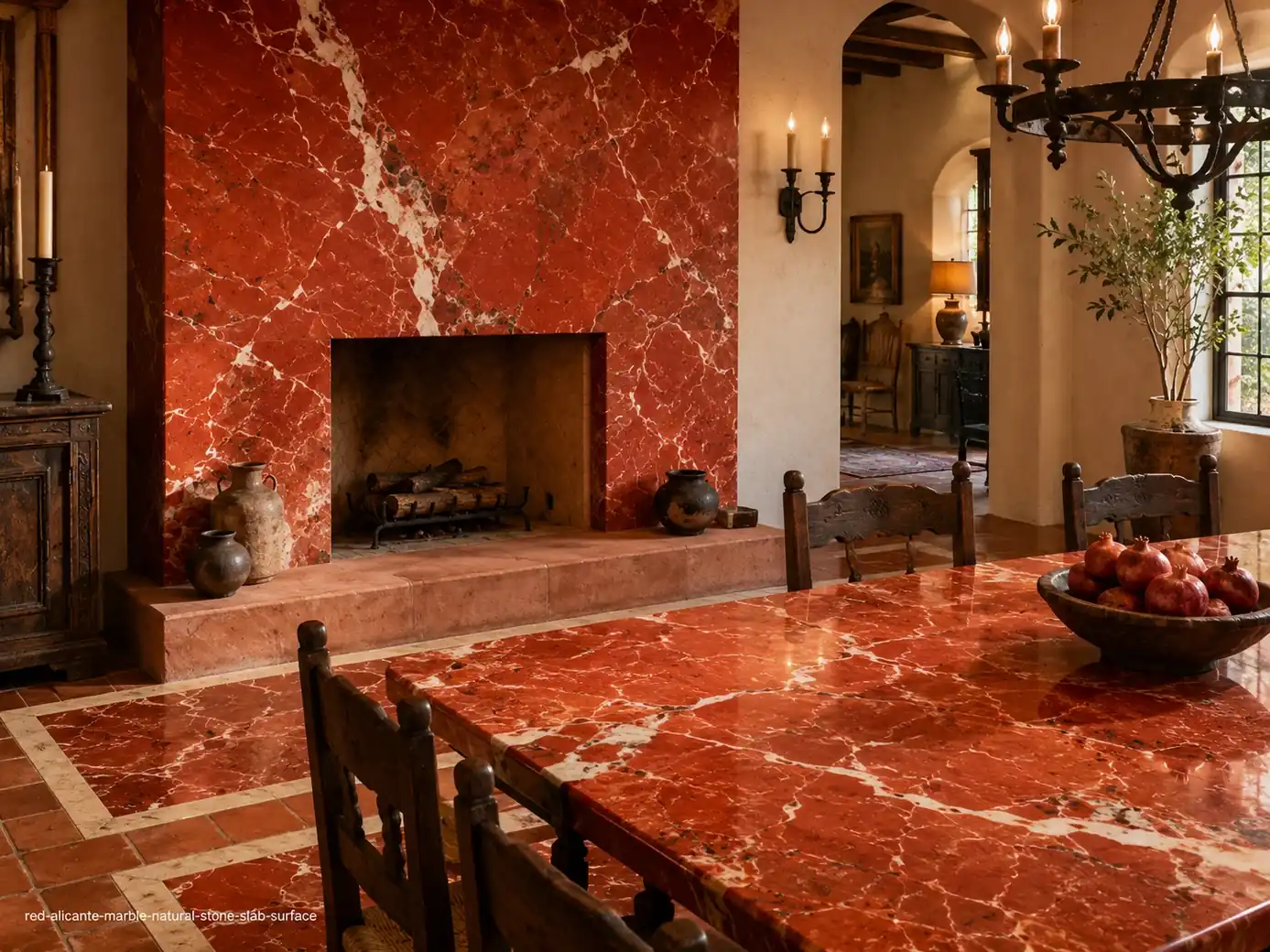
Rojo Alicante Marble is a warm terracotta architectural slab with a saturated background ranging from coral and brick red to deeper crimson. Approximate tones include #9C4238 for the principal red field, #78342F for darker areas, #C06A55 for coral variation, #E2D5C5 for ivory veins and #A5A19C for occasional grey details. Irregular white and cream calcite lines form hairline fractures, branching networks and broader angular seams. Brown, grey and near-black mineral marks may accompany the pale veins, adding geological depth. Some slabs contain open red areas with sparse movement, while others display dense spider-web patterns and scattered pale fragments. Polishing intensifies the red and sharpens the ivory contrast. Honing creates a softer fired-clay or aged-leather appearance with subdued veins.

Warm terracotta architectural slab on a dining fireplace, table and floor inlays with coral red and ivory calcite veining.
Polished classical luxury surface enriches a dining fireplace, table and floor with terracotta red and ivory calcite veins.

White Veins, Spanish Heritage, Enduring Strength

Warm Terracotta Architectural Slab: Spanish Origin and Strength

Alicante Red Marble is extracted from the Monóvar and Novelda stone district of Alicante, Spain, with the Cavarrassa quarry recognised as a major source. Geologically, the deposit belongs to the External Subbetic domain of the Baetic Cordillera and developed from Jurassic nodular red limestones associated with the Ammonitico Rosso facies. Published reference values include approximately 0.30% porosity, 94.61 MPa compressive strength and 8.73 MPa bending strength. The relatively modest flexural value means narrow stair sections, sink bridges and unsupported shelves require careful span design and reinforcement. Standard production includes slabs and tiles in approximately 20–40 mm thicknesses. Pale calcite seams should be inspected before internal corners and tap holes are cut. The polished classical luxury surface is appropriate for floors, walls and decorative interiors, while acid sensitivity, slip resistance and quarry-specific frost performance must be considered for kitchens, wet floors and exterior work.

Classic finishes, practical slab formats and warm interiors.

Mediterranean Finishes, Sizes & Uses

Premium Mediterranean cladding is widely available polished and honed, with brushed, antiqued or satin finishes suitable for traditional and contemporary interiors. Polished Alicante Rosso Marble is effective for reception counters, fireplace surrounds, decorative wall panels and statement furniture, while honing or antiquing creates a softer surface for floors, staircases and hospitality spaces. Full slabs commonly range from approximately 2,300–3,000 × 1,200–1,750 mm, with 20 mm and 30 mm as the standard thicknesses. Twenty-millimetre slabs suit supported wall cladding and furniture, while 30 mm provides greater stability for counters, stair treads and exposed edges. Interior applications include hotel lobbies, dining rooms, bathroom vanities, floor borders, lift surrounds and feature fireplaces. Large installations should be dry-laid before cutting so active and quieter pieces are distributed intentionally. Wet floors require tested slip resistance, while countertops should receive a penetrating sealer and protection from acidic substances and abrasive cleaners.

Mediterranean bathrooms, easy care, wise selection

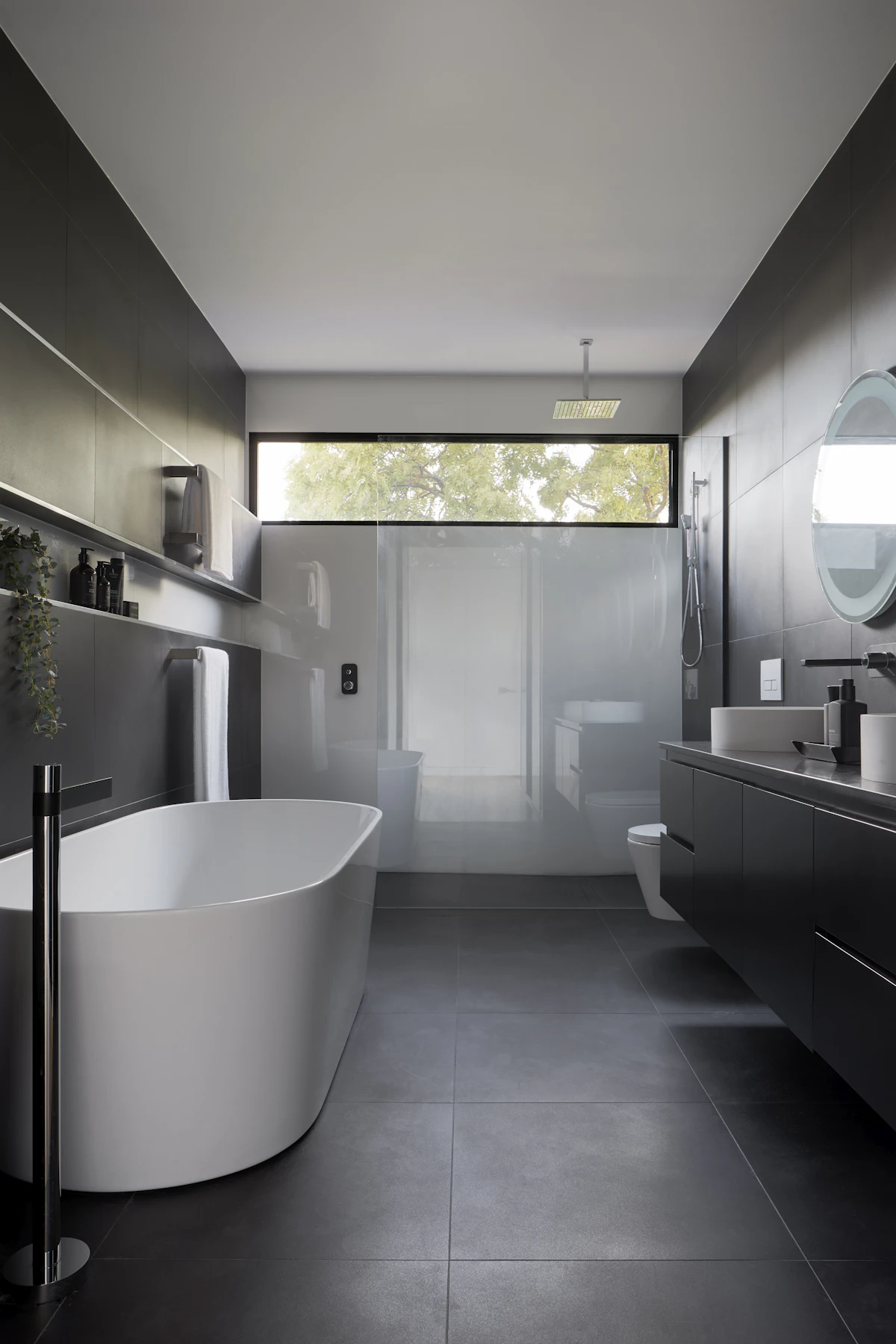
Brick-Red Texture Bathroom Guide

Alicante Rosso Marble works well on vanity counters, bath surrounds, feature shower walls and expressive brick red mineral texture installations. Honed or aged smaller-format pieces are preferable in wet floor zones, while polished slabs can be used vertically where the stronger colour remains protected from abrasion. Review the complete slab bundle because dense calcite networks can reduce usable yield and should not pass through basin corners, tap holes or narrow counter rails without reinforcement. Specify a waterproof substrate, compatible low-stain adhesive and flexible sealant at internal corners. Cosmetics, hair dye and acidic toiletries should be removed promptly, and routine maintenance should use neutral cleaner followed by rinsing and drying. Factory listings currently range from USD 25–35 to about USD 125 per square metre, equivalent to approximately AED 92–459 using the official USD/AED peg; selected UAE slabs, small quantities and fabricated pieces will cost more.

UseFinishThicknessIndoor / sqmOutdoor / sqmSupplyInstalledNotes
Feature Wall Panels Polished 15 mm / 20 mm Indoor Use Preferred Covered Exterior Walls Only AED 280–380/m² AED 120–170/m² Protect from direct weather and prolonged moisture
Fireplace Surrounds Polished / Honed 20 mm / 30 mm Indoor preferred — living rooms and formal lounges Covered Outdoor Fireplaces Only AED 220–320/m² AED 130–200/m² Affordable fireplace feature for protected lounges and covered exteriors
Dining Table Tops Polished / Honed 20 mm / 30 mm Indoor preferred — dining rooms and formal lounges Limited — covered outdoor dining areas only AED 220–320/m² AED 90–140/m² Mid-range dining-top choice; use coasters and reseal periodically; covered dining areas only.
Bathroom Vanity Tops Polished / Honed 20 mm / 30 mm Indoor preferred — bathrooms and powder rooms Limited — covered outdoor bathrooms only AED 220–320/m² AED 90–150/m² Mid-range bathroom top; protect from cosmetics and standing water.
Decorative Flooring Tiles Honed / Brushed 20 mm / 30 mm Indoor preferred — foyers, lounges and feature floors Limited — covered patios and walkways only AED 220–320/m² AED 100–160/m² Mid-range vanity surface; honed finish and regular sealing recommended.

Ideal for floors, countertops and walls

Floors, Counters & Walls

Alicante Marble is a sophisticated heritage feature stone for warm floors, countertops and wall cladding. Use honed or brushed tiles in entrance halls, dining areas and traditional hospitality interiors, distributing stronger mineral sections before fixing. Countertops are best suited to bars, vanities, consoles and moderate-use islands where natural patina is acceptable; seal them and protect against acids, oil, direct cutting and heat. Wall cladding can frame fireplaces, columns and reception desks with large panels. Choose warm, colour-matched joints and restrained surrounding finishes so the historic character remains intentional rather than visually crowded.

sophisticated heritage feature stone across wall cladding, flooring and a stone countertop, with authentic slab variation.
sophisticated heritage feature stone shapes wall cladding, flooring and countertop, with natural pattern and refined depth.

Rich, durable and versatile, but visually dominant, porous and care-intensive.

Color, Performance and Value

This Spanish quarried stone combines a rich red background with white veining in polished, honed and textured slabs for floors, countertops, walls and bathrooms. Its bold colour improves warmth and distinctive character, so interior designers worldwide suggest grounding it with a restrained <a href="https://arifeenraisedfloor.com/">raised floor</a>. Check performance, dimensions, thickness, sealing, care, fabrication and price before selection.

Beauty and Considerations

Pros

  • Authentic Alicante quarry provenance
  • Compact fine-grained structure
  • Rich red field with irregular white veins
  • Multiple interior and exterior finishes
  • Suitable for floors counters walls and bathrooms

Cons

  • Saturated red can dominate small interiors
  • White veins vary significantly
  • Acidic spills visibly etch polished areas
  • Polished wet floors need slip control
  • Spanish quarry grades can differ in consistency.

Red-White Contrast Surfaces, Floors, Worktops & Wall Fit

Where Red Alicante’s White Veining Works Best

Red Alicante works especially well for entrance flooring, staircases, wall cladding, fireplace surrounds and traditional bathroom details, where its vibrant Spanish red ground and pale veining provide enduring contrast. The stone is quarried in the Alicante and Murcia region and is available for interior architectural fabrication. Select slabs from one quarry lot for consistent colour, and seal counters against acids and staining.

UseWeatherConditionApplicationSlipCareBest forAvoid for
Powder-room vanity tops Ideal for climate-controlled bathroom interiors; covered patios only in dry climates Suited to light-use powder rooms with gentle cleaning and moisture control Powder-room vanities, guest washrooms and dressing counters Slip rating is not applicable to powder-room vanity tops Wipe after use, avoid acidic toiletries and reseal around basin cut-outs Expressive vanity tops for stylish powder rooms Constant moisture, acidic cosmetics and heavily used public washrooms
fireplace surrounds Best for indoor fireplaces; exterior surrounds need shade and rain protection Suited to stable fireplace surrounds protected from excessive heat and staining Luxury villas, formal lounges, boutique hotels and living rooms Slip resistance does not apply to fixed fireplace surrounds Dust regularly, avoid staining and protect from excessive direct heat Stable indoor fireplace surrounds in villas, lounges and boutique hotels Direct flame contact, excessive thermal shock and soot-prone outdoor fireplaces
sculptural coffee tables Keep preferably indoors; covered exterior use is limited to dry, low-humidity weather. Protected sculptural tables with stable support and controlled staining Sculptural coffee tables for lounges, villas, boutique hotels and galleries Slip performance is irrelevant to the raised tabletop application Protect edges from impact, use coasters and reseal the tabletop periodically Sculptural coffee tables for lounges, galleries and boutique hotels Outdoor terraces without shelter, unstable bases and heavy objects
feature-wall panels Performs best on interior walls; outdoor use is limited to sheltered, arid conditions. Firmly anchored statement panels with sealed joints and low abrasion Statement feature walls in luxury residences, hotel lobbies, offices and upscale retail interiors. This non-floor Red Alicante installation carries no pedestrian slipping exposure. Keep Red Alicante dry, remove fingerprints promptly and check sealant lines and anchors during routine maintenance. Red Alicante suits statement feature walls in luxury residences, hotels and retail interiors. Not suited to shower enclosures, exposed façades or walls vulnerable to trolley impact, where protective detailing cannot be assured.
boutique reception desks Preferable in stable indoor conditions; outdoors only where rain, intense sun and standing moisture are excluded. Climate-controlled lobby areas with balanced temperatures, sealed surfaces and careful edge protection. Reception desks for boutiques, salons, galleries and intimate hospitality spaces. Pedestrian grip is not a performance requirement for this desk; surface care matters more than traction grading. Clean daily-contact areas carefully with microfiber, avoiding harsh chemicals; schedule periodic sealing based on the stone’s absorption. Protected welcome counters in boutiques, salons, galleries and intimate hospitality spaces. Open-air reception desks, frequent uncleaned spills, poorly protected corners and harsh chemical maintenance.
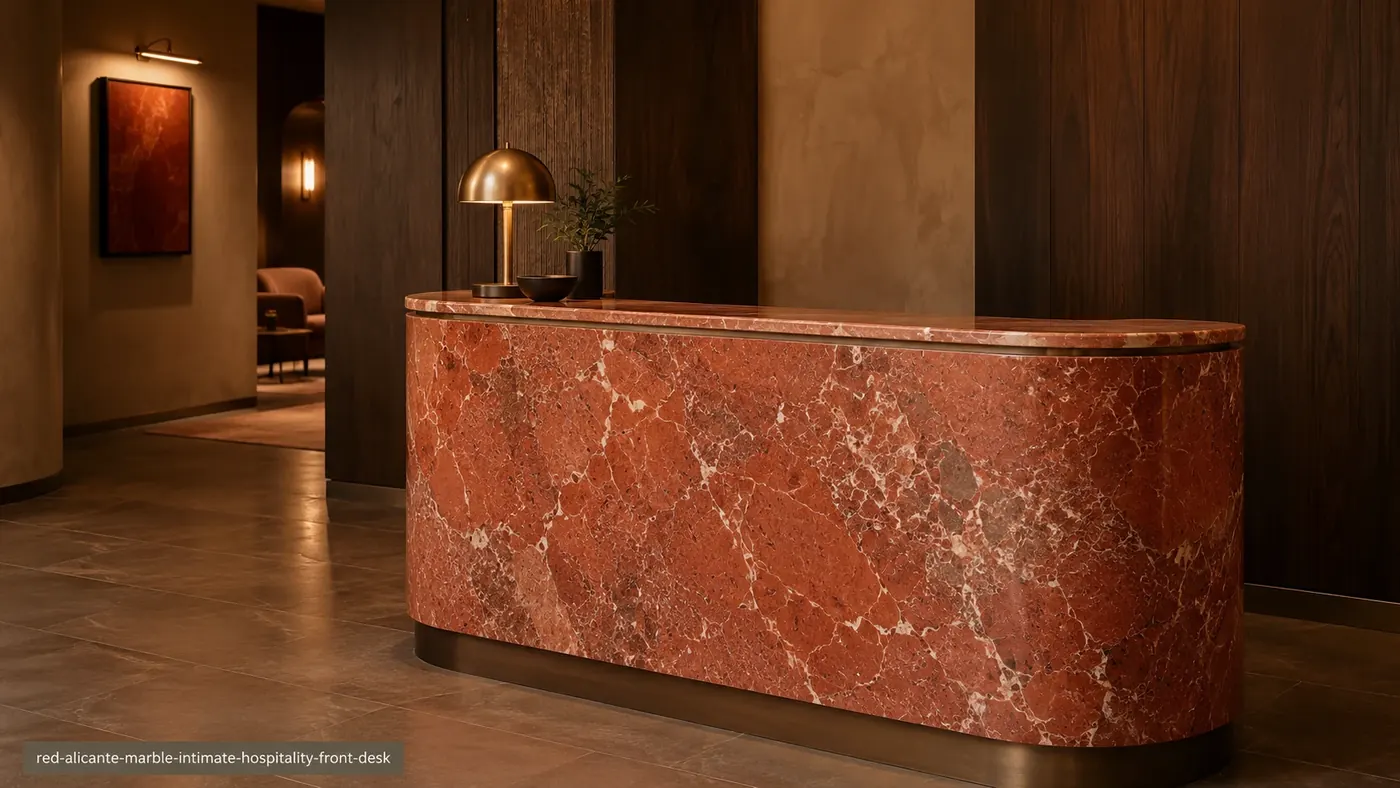
Red Alicante Marble front desk with honed terracotta-red stone, ivory calcite lines and grey-brown details.
Red Alicante Marble gives this intimate front desk warm terracotta stone and restrained ivory calcite lines.

Intimate hospitality front desks.

Intimate Hospitality Front Desks

A warm terracotta architectural slab creates intimate hospitality front desks with a welcoming, distinctive identity suited to boutique hotels, restaurants and private clubs. Alicante Red Marble should be arranged so the most balanced red areas serve writing and payment functions while stronger mineral movement enriches the guest-facing fascia. Use continuous cabinet support and concealed reinforcement beneath visitor ledges. Align seams with internal modules or level changes and protect exposed corners from luggage. A honed finish offers a softer hospitality character. Seal the surface and use pads beneath sanitiser, printers, ink accessories and metal equipment.

Red Alicante FAQ

Questions about Red Alicante

Answer

What does Red Alicante Marble's Spanish Alicante origin reveal about its terracotta versus crimson variation and ivory calcite vein density?

Red Alicante or Rojo Alicante is Spanish marble produced from quarrying areas in Alicante and Murcia including the Cavarrasa quarry at Monóvar and El Cantón at Abanilla. Iron-rich sections create deeper brick-red or crimson colour while lighter mineral concentrations produce coral and terracotta fields. Premium open-red slabs have restrained ivory calcite lines while more fractured grades contain dense white spider veins and pale angular inclusions.